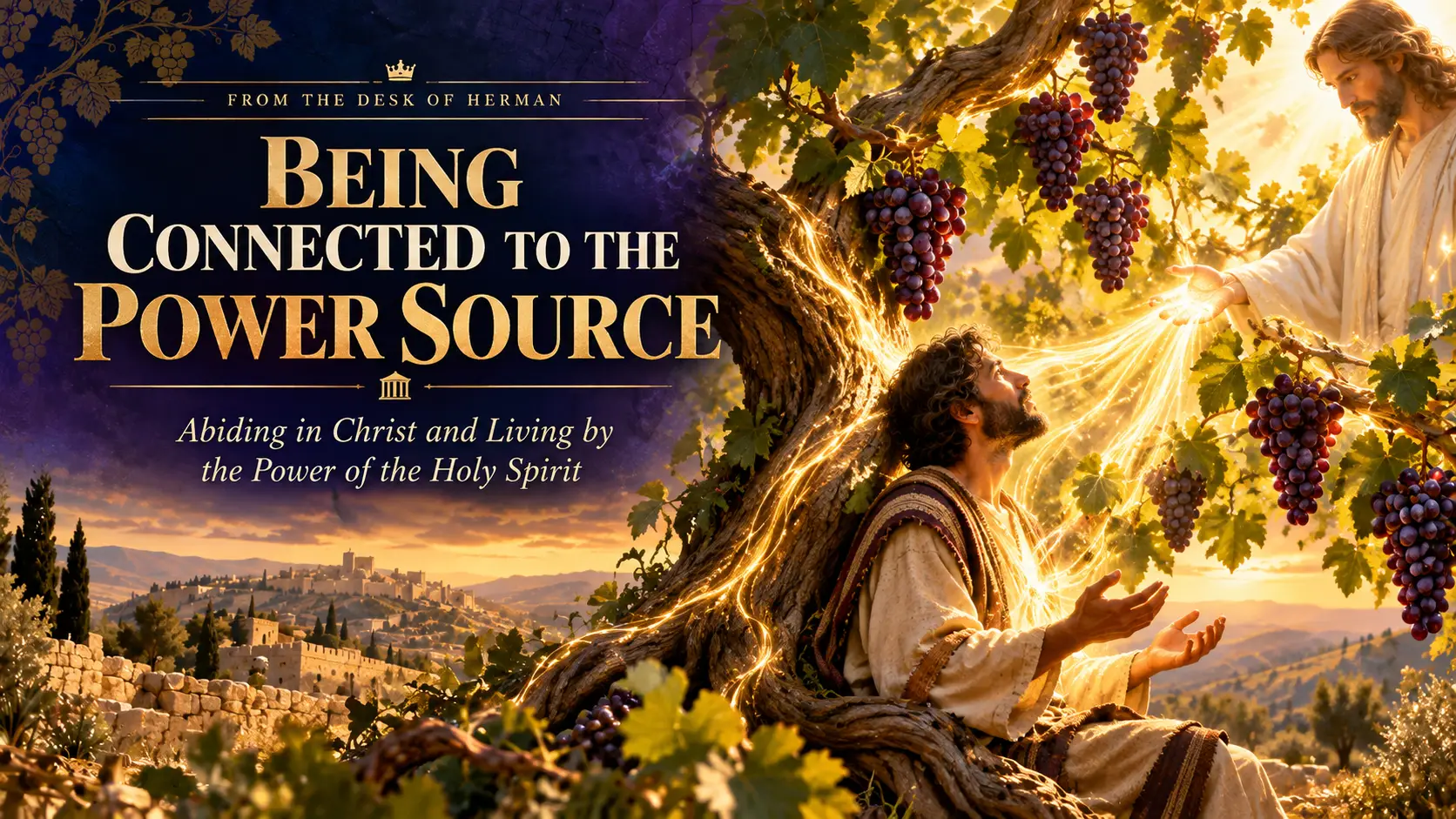
From the Desk of Herman — Part 2 of 6
Abiding in Christ and Living by the Power of the Holy Spirit
Every healthy spiritual household must answer a foundational question: from where does its life, strength and fruitfulness come? Scripture directs us away from personality, technique and self-reliance and back to union with Christ and the indwelling Holy Spirit.
God Is the Source of All Spiritual Power
Zechariah 4:6 “This is the word of the LORD to Zerubbabel: Not by might nor by power, but by My Spirit, says the LORD of Hosts.”
Power belongs to God (Psalm 62:11). Strength, greatness, glory, victory, and majesty are His, and He gives strength to His people according to His purpose (1 Chronicles 29:11 to 12). Human ability has value, but it cannot produce spiritual life. Organisation can arrange activity, education can communicate information, personality can attract attention, and discipline can shape habits. None of these can regenerate the heart, reveal Christ, overcome the flesh, or produce the fruit of the Spirit.
God’s power is revealed through the Father, the Son, and the Holy Spirit. The Father is the source from whom every good gift comes (James 1:17). The Son is our life, wisdom, righteousness, sanctification, and redemption (1 Corinthians 1:30; Colossians 3:4). The Holy Spirit indwells believers, strengthens the inner person, makes Christ known, produces holy fruit, distributes gifts, and empowers witness (John 16:13 to 14; Acts 1:8; Ephesians 3:16 to 17).
The believer does not possess divine power as private property. We remain dependent stewards. God supplies strength for His will, at His time, and for His glory. This protects us from pride when ministry is fruitful and from despair when our human strength is small.
The Biblical Pattern of Connection
Scripture presents a clear order. God is the Source, Christ is the One to whom we are united and through whom we receive life, and the Holy Spirit makes that life active within us. The Word, prayer, obedience, fellowship, and service are means God uses to keep us responsive to Him. They are not substitutes for Him.
Three Dimensions of Connection With God
Union With Christ
At salvation, the believer is united with Christ through faith and sealed with the Holy Spirit (Ephesians 1:13 to 14). Scripture says that the person joined to the Lord is one with Him in spirit (1 Corinthians 6:17). This union rests on grace and the finished work of Christ, not on fluctuating feelings or perfect performance. A difficult day does not mean that Christ has abandoned His child.
Communion With God
Union describes the believer’s covenant position in Christ; communion describes the lived fellowship that flows from it. Sin, stubbornness, neglect, and distraction do not make God powerless, but they can grieve the Spirit, dull spiritual sensitivity, damage fellowship, and reduce fruitfulness (Ephesians 4:30; 1 Thessalonians 5:19; 1 John 1:6 to 9). Confession and repentance do not purchase acceptance. They restore honesty and agreement with the God who has already called us into fellowship.
Expression of Divine Life
The life received in Christ must become visible. The Spirit produces character, gives gifts, empowers witness, strengthens endurance, and enables service (Galatians 5:22 to 23; 1 Corinthians 12:4 to 11; Colossians 1:11). Genuine power is therefore measured by faithfulness to Christ and the fruit it produces. Noise, excitement, public visibility, and unusual manifestations are not sufficient evidence by themselves.
The Vine and the Branches
John 15 gives the clearest biblical picture of connection. Jesus is the vine. The Father is the gardener. Believers are the branches. The branch does not support the vine; the vine sustains the branch. The branch does not create life; it receives life and expresses that life in fruit. This corrects the pride that says, I can do God’s work in my own strength, and the anxiety that says everything depends on me.
Remain in Christ Abiding means continuing in trusting relationship with Jesus, receiving His words, obeying His commands, and living in His love (John 15:7 to 10).
Accept the Father’s pruning God removes what is fruitless and disciplines what can become more fruitful. Pruning may involve correction, changed priorities, hidden seasons, or the surrender of activities that consume life without serving His purpose (John 15:2; Hebrews 12:10 to 11).
Expect fruit rather than self-display The purpose of connection is fruit that glorifies the Father: Christlike character, answered prayer aligned with His will, love, witness, and lasting discipleship (John 15:7 to 8 and 16).
Recognise dependence Apart from Christ we can do nothing of eternal value. Dependence is not passivity. It is active obedience carried out in strength received from Him.
Abiding is not a frantic attempt to keep Christ from leaving. It is the daily response of faith to the One who has taken hold of us. We remain by trusting His finished work, receiving His Word, turning quickly from sin, and obeying the grace He supplies.
Living by the Power of the Holy Spirit
Acts 1:8 “But you will receive power when the Holy Spirit comes upon you, and you will be My witnesses in Jerusalem, and in all Judea and Samaria, and to the ends of the earth.”
The Holy Spirit is not merely an influence. He is the Spirit of God who indwells believers and makes the life of Christ effective within them. The same Spirit who raised Jesus from the dead lives in us and gives life to our mortal bodies (Romans 8:11). He strengthens the inner person, leads God’s children, produces holiness, reveals Christ, distributes gifts, and gives boldness for witness.
Paul commands believers to be filled with the Spirit (Ephesians 5:18). The language points to an ongoing life under His influence. We are sealed by the Spirit once for redemption, yet we must continually yield our thoughts, desires, speech, relationships, gifts, and decisions to His government. Walking by the Spirit means responding to His leading in agreement with Scripture and refusing the desires of the flesh (Galatians 5:16 and 25).
The Spirit’s power often becomes clearest in human weakness. God told Paul that His grace was sufficient and His power was perfected in weakness (2 Corinthians 12:9). Weakness that drives us to dependence can become the place where Christ’s strength rests upon us. This does not glorify sickness, exhaustion, or suffering. It means human limitation cannot prevent God from accomplishing what He has appointed.
Biblical Means That Sustain Spiritual Vitality
God is the Source, yet He has appointed ordinary means through which believers receive truth, respond to grace, and remain spiritually alert. These practices have no power when separated from faith and relationship, but they form a healthy rhythm of abiding.
The Word of Christ
Jesus said that His words are spirit and life (John 6:63). Scripture renews the mind, exposes motives, nourishes faith, and equips the believer for every good work (Romans 12:2; Hebrews 4:12; 2 Timothy 3:16 to 17). Letting the Word of Christ dwell richly within us means more than collecting verses. We read in context, meditate, receive correction, and practise what God says (Colossians 3:16; James 1:22 to 25).
Prayer and Worship
Prayer is the language of dependence. We come to the throne of grace for mercy and timely help (Hebrews 4:16). Prayer aligns the heart with God’s will, carries burdens to Him, asks for wisdom, and makes room for intercession. Worship restores proper perspective by directing attention away from self-sufficiency and toward the greatness and faithfulness of God (Ephesians 6:18; Philippians 4:6 to 7).
Obedience
Obedience keeps the believer in practical agreement with Christ. Jesus connected love with keeping His commands and promised the continuing fellowship of the Father and Son to those who love and obey Him (John 14:21 to 23). Disobedience resisted over time dulls the conscience. Prompt obedience strengthens discernment because truth is being practised rather than merely discussed.
Repentance and a Clear Conscience
Confession brings hidden matters into the light. God is faithful and just to forgive and cleanse those who confess their sins (1 John 1:9). A clear conscience does not mean sinless perfection. It means that we refuse known compromise, make restitution where necessary, and respond when the Spirit convicts us (Acts 24:16; Proverbs 28:13).
Faith
Faith receives what God supplies. The message heard did not benefit Israel because it was not united with faith (Hebrews 4:2). Faith does not deny weakness or difficult circumstances. It gives greater authority to God’s character and promise than to fear, appearance, or past disappointment. We live by faith in the Son of God who loved us and gave Himself for us (Galatians 2:20).
Fellowship and the Body of Christ
Christ supplies His body as every part remains connected to the Head and serves in relationship with the other parts (Ephesians 4:15 to 16; Colossians 2:19). Fellowship provides encouragement, correction, shared wisdom, prayer, and the gifts of others. Isolation makes believers more vulnerable to discouragement, deception, and self-centred interpretation. Biblical fellowship supports personal responsibility; it does not replace it.
Rest and Ordered Living
Spiritual weariness is not always evidence of sin. Elijah reached a point of fear and exhaustion, and God first provided sleep, food, water, and quiet before giving further direction (1 Kings 19:4 to 13). Bodies have limits. Ordered rest, wise boundaries, and attention to health can protect our capacity to pray, think clearly, love patiently, and serve faithfully. Rest becomes an act of trust when we acknowledge that God continues to govern while we sleep.
Service and Witness
Grace is expressed through faithful use. Each believer should serve with the gift received, relying on the strength God provides so that He receives the glory (1 Peter 4:10 to 11). The Spirit’s power is not given for spiritual display. It equips us to testify of Christ, build others, confront darkness, show mercy, administer faithfully, and complete the work God has assigned.
Conditions That Hinder Spiritual Vitality
A believer’s union with Christ rests on grace, but lived fellowship and fruitfulness can be hindered. The following conditions should be faced honestly.
Pastoral caution Weakness, grief, illness, trauma, and exhaustion should not automatically be labelled spiritual failure. Scripture makes room for lament, rest, practical care, patient support, and gradual restoration. Honest examination asks whether repentance is needed, but it does not condemn the weary for having human limits.
Counterfeit Power Sources
Where dependence on God is weak, substitutes quickly appear. A counterfeit may produce excitement, loyalty, or visible results while leaving people immature and dependent. Every claim to spiritual power must be tested by Scripture, the gospel of Christ, moral fruit, and its effect on the body.
Human personality A gifted leader can point people to Christ, but the leader must never become the source of identity, guidance, or spiritual security. Paul planted and Apollos watered, but God gave the growth (1 Corinthians 3:5 to 7).
Emotional intensity Strong feelings may accompany God’s work, but emotion is not proof of truth. Faith rests on God’s character and Word even when feelings are quiet or unsettled (2 Corinthians 5:7).
Signs without truth and character Jesus warned that impressive works do not replace obedience and relationship with Him (Matthew 7:21 to 23). Spiritual manifestations must be tested rather than accepted because they are dramatic (1 John 4:1).
Methods formulas and objects The sons of Sceva tried to use the name of Jesus as a technique without knowing Him (Acts 19:13 to 16). Biblical practices serve relationship; they do not control God or guarantee outcomes.
Money position and influence Simon wanted to purchase spiritual authority for personal advantage (Acts 8:18 to 23). The Spirit’s gifts are grace, not commodities, status symbols, or tools of control.
Activity without communion Ministry busyness can continue after inward attention has shifted away from Christ. Work for God must continue to flow from listening, receiving, and obeying Him (Luke 10:38 to 42).
The most reliable evidence of spiritual power is not spectacle. It is a life that confesses Jesus faithfully, obeys Scripture, produces the fruit of the Spirit, serves without manipulation, and endures when obedience becomes costly.
Restoring Living Fellowship With the Source
When believers speak of reconnecting with God, they should not imply that every dry season requires a new salvation. Those who belong to Christ are called to return to active fellowship, renewed faith, honest obedience, and dependence on the Spirit. James 4:8 says, Draw near to God, and He will draw near to you.
1. Return your attention to Jesus. Confess that He is the Source and lay down the burden of self-sufficiency (Hebrews 12:1 to 3).
2. Ask the Holy Spirit to search your heart. Receive conviction without condemnation and identify any known disobedience, bitterness, pride, or unbelief (Psalm 139:23 to 24; Romans 8:1).
3. Confess and forsake what God exposes. Trust the cleansing promised through Christ rather than trying to punish yourself into acceptance (1 John 1:9; Proverbs 28:13).
4. Reopen the Word with a willing heart. Read a whole passage, listen for what it reveals about Christ, and obey the next clear instruction (John 14:21; James 1:22).
5. Pray honestly and specifically. Ask for wisdom, inner strength, fresh filling, and grace for the responsibility before you (Luke 11:13; Ephesians 3:16; Hebrews 4:16).
6. Return to trustworthy fellowship. Seek prayer, correction, encouragement, and practical help from mature believers (Galatians 6:1 to 2; Hebrews 10:24 to 25).
7. Restore rest and order where exhaustion has damaged attention. Receive appropriate pastoral, medical, or practical care when it is needed (1 Kings 19:5 to 8).
8. Take the next obedient step in faith. Spiritual vitality strengthens as received grace becomes obedient action (Philippians 2:12 to 13).
The Purpose of Divine Power
God’s power is purposeful. Scripture does not present power as a private spiritual sensation or a means of establishing superiority. The Spirit empowers believers to represent Christ and carry out His will.
Power for witness The Spirit gives boldness and ability to testify of the risen Christ locally and beyond familiar boundaries (Acts 1:8; 4:31).
Power for holy living By the Spirit believers put to death the deeds of the body and grow in freedom from the rule of sin (Romans 8:12 to 14).
Power for inner strength God strengthens the inner person so that Christ’s love governs the heart and the believer becomes established in Him (Ephesians 3:16 to 19).
Power for endurance Believers are strengthened with all power for perseverance and patience, especially when obedience must continue under pressure (Colossians 1:11).
Power for loving service The Spirit distributes gifts for the common good, and each part contributes to the growth of the body (1 Corinthians 12:7; Ephesians 4:16).
Power for faithful administration God supplies wisdom and strength for the work He assigns, allowing servants to labour with His energy rather than empty human striving (Colossians 1:29; 1 Peter 4:11).
Fathers Sons and the Household of Faith
A spiritual father or leader is a steward of grace, not the power source. Paul asked, What then is Apollos? And what is Paul? They were servants through whom others believed, but God caused the growth (1 Corinthians 3:5 to 7). Healthy fathers lead sons to Christ, model dependence on the Spirit, teach the Word, create room for gifts to mature, and refuse to build personal dependency.
A mature son honours what he has received while learning to draw directly from Christ. He does not imitate the father’s personality or rely permanently on the father’s strength. He becomes strong in the grace that is in Christ Jesus, carries sound teaching faithfully, and equips others in turn (2 Timothy 2:1 to 2). Because he is connected to the Head, he can build the father’s house with conviction, endurance, and personal responsibility.
Keep Christ visibly central in teaching, worship, decision making, and correction.
Teach sons and members to study Scripture, pray, hear responsibly, and test spiritual impressions.
Recognise and develop diverse gifts without turning gifting into rank or competition.
Maintain accountable leadership so that authority remains servant shaped and truthful.
Create a culture where confession, correction, forgiveness, rest, and restoration are normal.
Measure household strength by love, maturity, obedience, service, and multiplication rather than dependence on one leader.
Signs of a Life Connected to the Source
Jesus Christ becomes more central than self, platform, gifting, or human approval.
The fruit of the Spirit becomes increasingly visible in character and relationships.
Obedience becomes more prompt, and repentance becomes more honest.
Prayer expresses trust and dependence rather than panic or performance.
Scripture governs decisions, corrects preferences, and renews the mind.
Gifts are used to build others rather than establish personal importance.
Weakness produces deeper dependence instead of pretence or despair.
The believer remains faithful through pressure, delay, correction, and hidden seasons.
Power is expressed through love, self-control, courage, truthfulness, and service.
Others are equipped to know Christ and mature rather than being kept dependent.
A Practical Daily Rhythm of Abiding
1. Begin with surrender. Acknowledge that the day, your body, your gifts, and your responsibilities belong to God (Romans 12:1).
2. Receive from Scripture. Read attentively, ask what the passage reveals about Christ, and identify one response of faith or obedience (Colossians 3:16).
3. Pray for filling and guidance. Ask the Spirit to govern your mind, words, relationships, and decisions (Ephesians 5:18; Galatians 5:25).
4. Obey what is already clear. Do not wait for a dramatic experience before taking the next faithful step (James 1:22).
5. Remain attentive during the day. Turn anxieties into prayer, receive needed correction, and notice opportunities to serve or witness (Philippians 4:6; Colossians 4:5 to 6).
6. Stay connected to the body. Give and receive encouragement, prayer, truth, and practical support (Hebrews 3:13).
7. End with examination and thanksgiving. Confess failure, recognise grace, release unfinished burdens, and rest in God’s faithfulness (Psalm 4:8; 139:23 to 24).
This rhythm is a guide, not a law. Its purpose is to cultivate attention and responsiveness. The believer’s confidence remains in Christ, not in completing a devotional routine perfectly.
Questions for Personal and Corporate Reflection
1. Do I understand God as the Source, or am I depending mainly on my ability, experience, position, or discipline?
2. Is my confidence rooted in union with Christ, or does it rise and fall entirely with emotion and visible results?
3. Which practice of abiding has become neglected: Scripture, prayer, obedience, fellowship, rest, or service?
4. Is there known disobedience, pride, bitterness, fear, or unbelief hindering honest fellowship with God?
5. Do the spiritual influences I receive lead me toward Jesus, Scripture, holiness, love, and mature responsibility?
6. Am I seeking power for witness and service, or for recognition, control, security, or personal importance?
7. How do I respond when God prunes an activity, relationship, ambition, or habit that is not bearing lasting fruit?
8. Do I allow weakness to drive me into dependence, or do I hide it through pretence and overactivity?
9. Am I connected to trustworthy believers who can encourage, correct, and pray with me?
10. Does my household connect people to Christ or make them permanently dependent on a leader?
11. What fruit is the present source of my strength producing in my character and relationships?
12. What is the next clear act of obedience through which I can respond to God’s grace?
Teaching Summary
God alone is the source of spiritual life and power.
Believers receive life through union with Christ and the indwelling Holy Spirit.
The Word, prayer, obedience, repentance, faith, fellowship, rest, and service sustain responsive fellowship; they do not replace the Source.
Self-reliance, unbelief, known disobedience, pride, isolation, distraction, and bitterness hinder spiritual vitality and fruitfulness.
Counterfeit power depends on personality, emotional intensity, signs without truth, formulas, money, influence, or activity without communion.
Divine power is given for witness, holiness, inner strength, endurance, loving service, and the building of Christ’s body.
Fathers and leaders are stewards who connect sons and households to Christ rather than to themselves.
A connected life is recognised by Christlike fruit, truthful witness, humble service, teachability, perseverance, and multiplication.
Closing Declaration and Prayer
Father, You are the source of life, strength, wisdom, and power. We confess that apart from Christ we can do nothing of eternal value. Deliver us from self-reliance, religious performance, counterfeit power, and dependence on human personalities. Root us deeply in Your Son and establish our hearts in His finished work.
Holy Spirit, fill us and strengthen us in the inner person. Bring the Word of Christ to life within us, expose what grieves You, renew our minds, and produce the character of Jesus in our relationships. Teach us to walk by faith, obey promptly, pray honestly, receive correction, and remain faithful when our human strength is small.
Make our households places where sons and believers are connected to Christ, equipped by the Word, matured through service, and released to build responsibly. Give fathers and leaders humility to remain stewards, courage to speak truth, and wisdom to develop others without creating dependency.
Let Your power be revealed through holy lives, courageous witness, patient endurance, compassionate service, and the building of Your body. May we labour with the energy You supply, give You all the glory, and bear fruit that remains.
In the name of Jesus Christ. Amen.
Series: From the Desk of Herman — Father and Son Wineskin Teaching Series, Part 2 of 6.
Unless otherwise indicated, Scripture quotations are from the Berean Standard Bible (BSB).
Herman Bouwer
777th Precinct Ministries