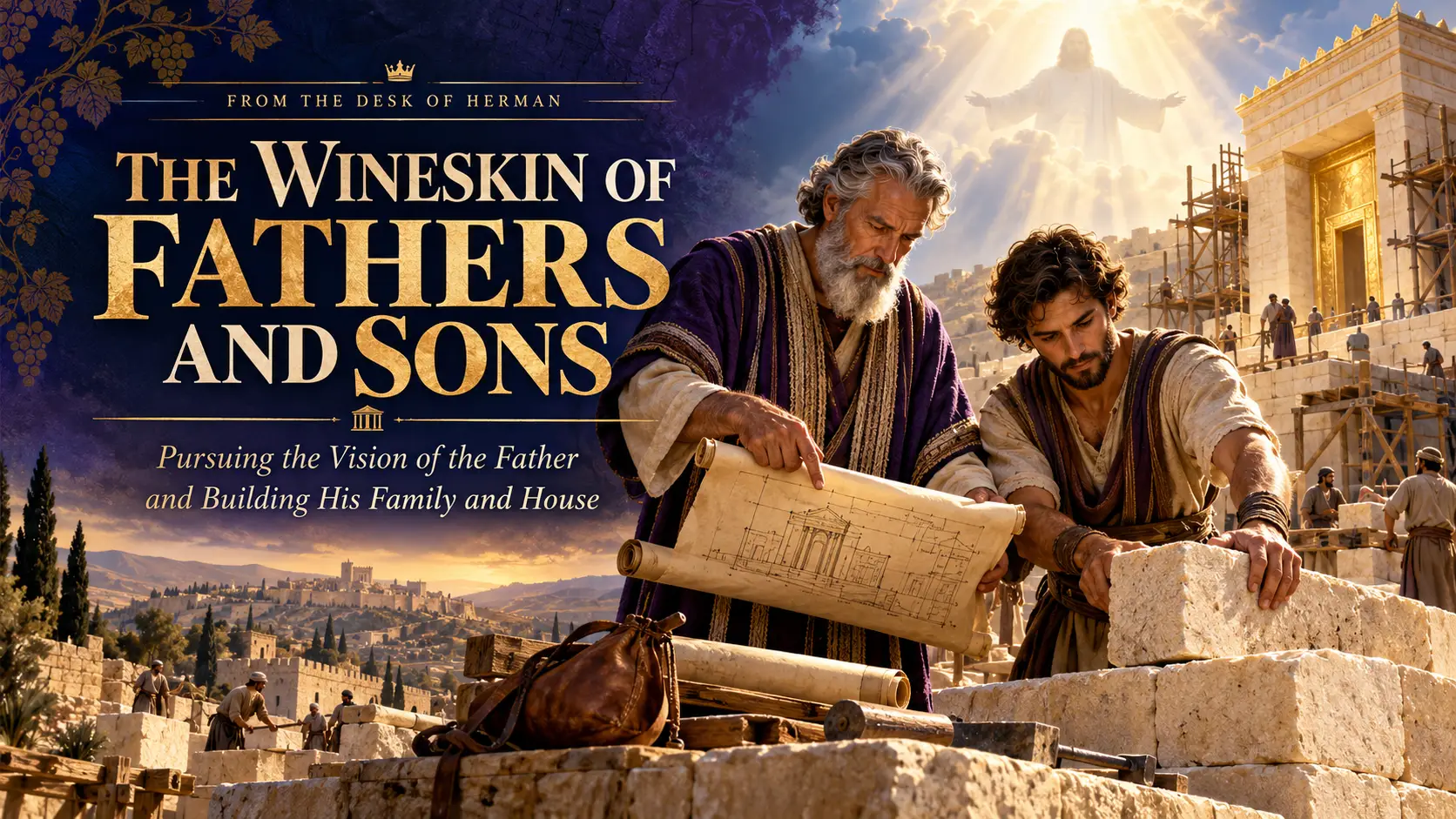
From the Desk of Herman — Part 1 of 6
Pursuing the Vision of the Father and Building His Family and House
A true son does not merely seek shelter, recognition, access or inheritance in a father’s house. He receives responsibility for the family, shares the burden of the God-given vision and gives himself to building what the father has been entrusted to steward. The father prepares, forms, equips, entrusts and releases. The son discerns, embraces, embodies, builds, preserves and extends. Both remain under the lordship of Jesus Christ, because the family and the house ultimately belong to God.
The Meaning of the Wineskin
Matthew 9:17 “Neither do people pour new wine into old wineskins. If they do, the skins
will burst, the wine will spill, and the wineskins will be ruined. Instead, they pour new wine into new wineskins, and both are preserved.”
Jesus used the picture of new wine and wineskins to explain that the life and reality He brought could not simply be contained within old religious forms. The passage does not directly define a father and son ministry model. The expression father and son wineskin is therefore an application of the image. It describes a relational structure capable of carrying the life of Christ, the work of the Holy Spirit, covenant responsibility, and generational purpose.
Wine represents living substance. A wineskin is the form that receives, carries, protects, and distributes that substance. A ministry structure can have correct language and still fail to The Wineskin of Fathers and Sons | Herman Bouwer | 2 carry life if its relationships are rigid, fearful, competitive, or controlled. A biblical wineskin must be strong enough to preserve truth and flexible enough to make room for growth, maturing sons, shared responsibility, and new expressions of the same Kingdom purpose.
The father and son wineskin is therefore relational and transformational. It cannot be reduced to attendance, public association, a title, or access to a leader. Covenant is revealed through a turned heart, shared Kingdom purpose, faithfulness under testing, a willingness to accept responsibility, and growth into maturity. Presence matters, but mere presence is not sonship. A person may attend every meeting and remain a spectator, while a true son carries the family and the assignment in prayer, conduct, service, sacrifice, and building.
The goal of this wineskin is not to keep people permanently dependent upon a spiritual father. Its purpose is to form mature sons who know God, hear Him, obey Scripture, govern themselves under Christ, accept responsibility, and faithfully carry Kingdom purpose.
Relationship replaces isolation, covenant replaces convenience, formation replaces performance, and shared responsibility replaces dependency.
The House Belongs to God
Psalm 127:1 “Unless the LORD builds the house, its builders labor in vain; unless the
LORD protects the city, its watchmen stand in vain.” Any teaching about the house of a father must begin with this foundation. God owns the house. Christ is its cornerstone and its Son. The people are living stones, and every human leader is a steward. When we speak of the family and house of a spiritual father, we mean the people, grace, relationships, values, mission, and responsibility that God has entrusted to his care. We do not mean a private religious possession or an empire built around a personality.
Ephesians 2:19 to 22 “You are no longer strangers and foreigners, but fellow citizens
with the saints and members of God’s household, built on the foundation of the apostles and prophets, with Christ Jesus Himself as the cornerstone. In Him the whole building is fitted together and grows into a holy temple in the Lord. And in Him you too are being built together into a dwelling place for God in His Spirit.”
Hebrews 3:1 to 6 distinguishes Moses, who was faithful as a servant in God’s house, from
Christ, who is faithful as the Son over God’s house. First Timothy 3:15 calls the church the household of God. First Peter 2:4 to 5 describes believers as living stones being built into a spiritual house. These passages keep our language in order. A father may carry grace for a household, but Christ remains the Head, foundation, cornerstone, owner, and final authority.
Jesus warned against religious titles that take the place belonging to God alone, declaring that we have one Father in heaven (Matthew 23:8 to 12). Paul nevertheless used father and child language to describe genuine spiritual formation, saying that he became a father through the gospel (1 Corinthians 4:14 to 17). The two passages are not contradictory. Jesus rejected self-exalting rank and spiritual ownership. Paul described a relational function through which the life of Christ was formed in people. Human fatherhood is valid only when it remains derived from, accountable to, and transparent before the Father in heaven.
The father does not replace Christ in the son’s life. The son does not surrender conscience, discernment, or personal accountability to God. The spiritual father helps the son become The Wineskin of Fathers and Sons | Herman Bouwer | 3 established in Christ. The son honours the father by faithfully building the God-given assignment, not by making the father the centre of faith.
The Biblical Pattern of Fathers and Sons
Malachi 4:6 “And he will turn the hearts of the fathers to their children, and the hearts of the children to their fathers. Otherwise, I will come and strike the land with a curse.”
The restoration begins in the heart. Biblical fathering cannot be manufactured by appointing a title, and true sonship cannot be imposed by demanding submission. God turns hearts. A father receives people as sons and gives himself to their formation. A son recognises grace, receives the relationship, and responds with honour, teachability, faithfulness, and responsibility.
1 Corinthians 4:15 “Even if you have ten thousand guardians in Christ, you do not have
many fathers; for in Christ Jesus I became your father through the gospel.” A guardian can supervise behaviour, but a father imparts life and forms identity. Paul did not merely transfer information to the Corinthians. Through the gospel he laboured for Christ to be formed in them. He could therefore send Timothy, his beloved and faithful child in the Lord, to remind them of his ways in Christ (1 Corinthians 4:16 to 17). Timothy carried more than Paul’s message. He could accurately embody and represent Paul’s ways in Christ.
Source Receives grace and vision from God and submits it to Scripture Recognises the grace and tests the vision under Christ Formation Models Christ, teaches, corrects, encourages, and develops capacity Receives instruction, practises truth, and grows in character Building Prepares the pattern, people, resources, and environment Accepts responsibility and builds the family and assignment Authority Entrusts responsibility and shares authority as maturity is proven Exercises entrusted authority with humility and accountability Inheritance Preserves and transfers wisdom, doctrine, relationships, and mission Guards, embodies, enlarges, and passes the inheritance onward Outcome Releases mature sons rather than maintaining dependants Becomes a responsible builder and eventually a father to others
David and Solomon as the Central Building Pattern
David and Solomon give one of the clearest pictures in Scripture of a father carrying a vision and a son building it. David desired to build a house for the name of the LORD. God did not permit David to complete the building, but He accepted the desire and appointed Solomon to carry it to fulfilment (1 Chronicles 22:6 to 10; 2 Chronicles 6:7 to 10). The vision was larger than the lifespan, role, and personal activity of the father. It required generational partnership.
The Wineskin of Fathers and Sons | Herman Bouwer | 4
The Vision Originated in God
David carried the desire, but the temple was not his private project. He gave Solomon the plans that he had received by the Spirit, and he testified that the LORD had made the details clear to him in writing (1 Chronicles 28:11 to 19). This establishes the first safeguard. A son is never called to pursue the ego, ambition, or unfinished fantasy of a man. He pursues a vision that has come from God, agrees with Scripture, serves God’s people, and places Christ rather than the father at the centre.
The Father Prepared What the Son Would Need
David did not merely announce a vision and demand that Solomon complete it. He prepared stone, timber, iron, bronze, gold, silver, skilled workers, leaders, and public support (1 Chronicles 22:2 to 5 and 14 to 19; 28:20 to 21; 29:1 to 9). He transferred understanding, resources, relationships, legitimacy, and encouragement. A true father does not hand a son an empty burden. He prepares an inheritance that gives the son a foundation from which to build.
The Son Was Specifically Chosen to Build
1 Chronicles 28:9 to 10 “As for you, Solomon my son, know the God of your father, and
serve Him wholeheartedly and with a willing mind … Consider now, for the LORD has chosen you to build a house for the sanctuary. Be strong and do it.”
David’s first instruction was not about architecture. He told Solomon to know God and serve Him wholeheartedly. The son could not build the father’s vision merely by copying the father’s techniques. He needed a personal relationship with the God of his father. Only then did David say, Be strong and do it. The order is decisive: know God, receive the charge, accept responsibility, and build.
The Son Had to Set His Own Heart
1 Chronicles 22:19 “Now set your heart and soul to seek the LORD your God. Begin
building the sanctuary of the LORD God.” A father can prepare material and communicate vision, but he cannot set the son’s heart on his behalf. Solomon had to seek the Lord and begin. A vision becomes generational only when it moves from the father’s heart into the son’s conviction. Borrowed language cannot carry a house through resistance. The son must personally see, believe, and embrace what God requires.
The Son Fulfilled the Vision of the Father
When the temple was completed, Solomon acknowledged that the LORD had fulfilled His promise to David and had enabled the son to build the house (2 Chronicles 6:4 to 10). The son’s accomplishment did not erase the father. The father’s preparation did not diminish the son. Their obedience formed one generational work, and God received the glory. This is the heart of co-regency: the son matures by walking, labouring, carrying authority, and governing with the father while the father is still present. Inheritance begins as shared responsibility, not only after death or retirement.
The Wineskin of Fathers and Sons | Herman Bouwer | 5 The central lesson is this The father may receive, carry, articulate, and prepare the vision, but the son is called to build the family and house so that the God-given purpose continues beyond the father’s personal capacity and season.
Additional Biblical Witnesses
Jesus and the Father
Jesus is the eternal and unique Son of God. No relationship between human leaders and believers may be treated as equal to His divine sonship. Yet His obedience gives the highest pattern of responsive sonship. He did what He saw the Father doing, sought the will of the One who sent Him, and completed the work He had been given (John 5:19 to 20; 4:34; 6:38; 17:4).
John 17:4 “I have glorified You on earth by accomplishing the work You gave Me to do.”
True sonship is therefore revealed in accurate representation and completed obedience. The son does not use relationship to avoid responsibility. He receives the work, embodies the father’s nature and purpose, and brings the assignment to completion. In every human father and son relationship, this pattern remains subject to the direct lordship of Christ.
Moses and Joshua
Scripture calls Joshua the assistant of Moses rather than his son, yet their relationship displays generational formation and succession. Joshua remained near the place of God’s presence, served faithfully, learned the way of leadership, received public commissioning, and was filled with the spirit of wisdom when Moses laid hands on him (Exodus 24:13; 33:11; Numbers 27:18 to 23; Deuteronomy 34:9). Moses brought Israel to the border; Joshua led the people into possession. The successor honoured the former assignment by carrying it into its next required phase.
Elijah and Elisha
Elisha left his former occupation, served Elijah, refused to abandon the journey at the point of transition, and received the mantle of responsibility (1 Kings 19:19 to 21; 2 Kings 2:1 to 15). His cry, My father, my father, reveals the relational nature of the succession. Elisha did not preserve the mantle as a memorial. He used it to serve his generation. A son honours inheritance by putting it to work.
Paul and Timothy
Philippians 2:20 to 22 “I have nobody else like him who will genuinely care for your
needs … But you know Timothy’s proven worth, that as a child with his father he has served with me in the work of the gospel.”
Timothy shared Paul’s genuine concern for the people. He did not pursue his own interests, and his worth had been proven over time. He knew Paul’s teaching, conduct, purpose, faith, patience, love, endurance, persecutions, and sufferings (2 Timothy 3:10 to 11). Paul could send him because Timothy carried the heart and ways of the house, not merely a borrowed sermon.
Paul then instructed Timothy to guard the good deposit and entrust what he had heard to faithful people who would teach others also (2 Timothy 1:13 to 14; 2:2). The inheritance was The Wineskin of Fathers and Sons | Herman Bouwer | 6 never intended to stop with Timothy. A son becomes a builder when he can receive faithfully, live accurately, transmit clearly, and prepare another generation.
Abraham and Isaac
Isaac reopened the wells that had been dug in the days of Abraham and restored the names his father had given them. He also dug new wells until the Lord made room for him (Genesis 26:18 to 22). This is continuity without cloning. A son preserves what carries covenant identity, removes what has obstructed the inheritance, and creates room for the purpose to expand in his own generation. He does not despise old wells merely because he did not dig them, and he does not refuse to dig new wells merely because his father did not name them.
The Son as Builder of the Family and House
A son is more than a recipient of fatherly care. He is a builder. He strengthens the relationships that make the people a family and the order that enables the family to fulfil its assignment. He does not merely ask what the house can provide for him. He asks what God has entrusted to him for the strengthening, fruitfulness, and future of the household.
Building the Family
The family consists of people joined in Christ through covenant love, shared identity, mutual care, and common purpose. Building the family means helping brothers and sisters become secure, connected, healed, mature, and fruitful. It includes honouring different gifts, carrying the weak, restoring those who stumble, reconciling conflict, refusing gossip and factions, protecting the dignity of others, and making room for younger sons to grow.
Ephesians 4:15 to 16 says that the whole body grows and builds itself up in love as every
part does its work. First Corinthians 12:25 to 27 rejects division and calls the members to equal concern for one another. Galatians 6:1 to 2 requires the spiritual to restore gently and carry one another’s burdens. A builder son therefore measures ministry fruit not only by meetings, projects, and visibility, but also by the health of relationships.
A son cannot truthfully claim to build the father’s house while fragmenting the father’s family. If he gathers private loyalties, competes with brothers, undermines trust, circulates suspicion, or uses access to the father to elevate himself, he weakens the very house he claims to serve. The spirit of sonship gathers and strengthens; the spirit of ambition isolates and divides.
Building the House
The house refers to the ordered expression of the family’s life and assignment. It includes doctrine, culture, discipleship, worship, mission, leadership, administration, stewardship, communication, resources, accountability, and succession. Love without order cannot sustain a growing household, and order without love turns the household into an institution. A builder son strengthens both.
1 Corinthians 3:9 to 11 “For we are God’s fellow workers; you are God’s field, God’s
building … But each one must be careful how he builds. For no one can lay a foundation other than the one already laid, which is Jesus Christ.”
The Wineskin of Fathers and Sons | Herman Bouwer | 7 The son builds on Christ and according to the God-given pattern. He brings solutions rather than merely reporting problems. He accepts tasks that are unseen, establishes reliable processes, cares for resources, keeps commitments, develops people, and completes work.
He learns to act with initiative while remaining transparent and aligned. Immaturity waits for constant instruction. Mature sonship understands the heart and purpose of the house well enough to make responsible decisions within entrusted authority.
Builders are planted rather than transient (Psalm 92:13 to 14). This does not mean that a son can never be sent, released, or given a distinct assignment. It means that he does not move according to offence, convenience, novelty, or ambition. When God changes a season, healthy fathers release without rejection and mature sons go without rupture. The relationship continues in honour even when the expression of the assignment changes.
Principles for Pursuing the Vision of the Father
Principle 1 Establish Your Sonship in God
A person must first be a son of God before he can function healthily as a spiritual son. Those led by the Spirit are sons of God, have received the Spirit of adoption, and are heirs with Christ (Romans 8:14 to 17). Identity that depends on a leader’s approval will produce fear, performance, jealousy, and unhealthy attachment. Identity received from the Father enables a son to honour a human father freely, without worshipping him or competing for position.
A secure son can receive correction without collapsing, carry responsibility without demanding applause, and be released without interpreting release as rejection. Spiritual fathering should strengthen this direct relationship with God, never replace it.
Principle 2 Discern the Source and Boundaries of the Vision
The vision must come from God, agree with Scripture, exalt Christ, and serve God’s people.
Psalm 127:1 warns that human labour is empty unless the Lord builds. First Thessalonians
5:19 to 22 requires believers to test what is presented and hold fast to what is good.
Galatians 1:8 places the gospel above every messenger. A son does not prove loyalty by
following error, concealing sin, or violating conscience. Once the son has prayerfully recognised the grace and assignment of the house, he can give himself to it with conviction. He is not merely pursuing the father’s personality or preferences.
He is serving the divine purpose carried through the father. This distinction gives both loyalty and freedom their proper place.
Principle 3 Turn Your Heart Before Offering Your Hands
Malachi 4:6 places the turning of hearts before the restoration of generations. A person can perform tasks while his heart remains distant, critical, opportunistic, or divided. That labour may support an event, but it will not build a family. The son first receives the people, burden, values, and future of the household into his heart.
Timothy was valuable because he genuinely cared for the people and did not seek his own interests (Philippians 2:20 to 22). The father’s vision becomes the son’s pursuit when the people are no longer someone else’s responsibility. The son begins to say, These are our people, this is our burden, and this is the work God has entrusted to us.
The Wineskin of Fathers and Sons | Herman Bouwer | 8
Principle 4 Understand the Vision and the Pattern
A son cannot accurately build what he has never taken time to understand. Habakkuk 2:2 shows the value of making a God-given vision plain. David gave Solomon plans, measurements, resources, and instructions (1 Chronicles 28:11 to 19). Paul expected Timothy to know his teaching, conduct, purpose, and manner of life (2 Timothy 3:10).
The son should be able to explain the vision in his own words, identify its biblical foundation, recognise its non-negotiable values, and distinguish these from the father’s personal style.
He must know what the house is building, why it matters, whom it serves, and what faithful progress looks like. Clarity prevents both passive dependence and unauthorised reinvention.
Principle 5 Receive the Ways of the Father in Christ
Paul sent Timothy to remind the Corinthians of his ways in Christ, not merely his words (1 Corinthians 4:17). A house carries a culture expressed through how truth is handled, how people are treated, how conflict is resolved, how resources are stewarded, and how authority is exercised. The son learns by proximity, observation, conversation, service, correction, and shared labour.
The phrase ways in Christ is an essential boundary. A son receives what reflects Christ. Human habits, weaknesses, prejudices, and methods are not automatically part of the inheritance. True honour does not reproduce dysfunction. It preserves grace and truth while allowing Christ to purify each generation.
Principle 6 Prove Faithfulness Through Shared Labour
Timothy’s worth was proven because he served with Paul in the work of the gospel (Philippians 2:22). Luke 16:10 connects faithfulness in little with faithfulness in much, and 1 Corinthians 4:2 requires stewards to be found faithful. A son does not demand authority before carrying responsibility. He becomes trustworthy through consistent service, truthful communication, completed assignments, and integrity when no one is watching.
Faithfulness is not passive compliance. It includes endurance when work is difficult, courage to speak truth respectfully, and willingness to remain steady when recognition is absent. The son carries the burden with the father rather than appearing only when the platform is visible.
Principle 7 Take Ownership and Build With Initiative
David told Solomon, Be strong and do it. At some point instruction must become action. A builder son does not remain in a permanent waiting posture, requiring the father to notice every need, design every response, and supervise every detail. He sees what serves the vision, develops a sound response, communicates clearly, and acts within the authority entrusted to him.
Ownership means that the son accepts the outcome of the work. He plans, gathers people and resources, solves problems, learns from mistakes, and completes what he begins. He does not use the language of alignment to excuse passivity. Neither does he use initiative to justify independence. Mature initiative remains transparent, accountable, and consistent with the pattern of the house.
The Wineskin of Fathers and Sons | Herman Bouwer | 9
Principle 8 Build the Family While Building the Work
A ministry can expand while its family is quietly being damaged. Biblical growth is different.
Ephesians 4:16 joins the effective work of every part to the building of the body in love. The
son asks not only whether the task succeeded, but also whether people were strengthened, dignity was preserved, communication was honest, and brothers were brought into fruitful participation.
The builder son refuses to make other sons smaller in order to make himself appear necessary. He shares knowledge, creates opportunities, celebrates the grace on others, and helps each member supply his part. He understands that the father’s vision is advanced by a mature family, not by one indispensable personality.
Principle 9 Remain Teachable and Guard the Truth
Proverbs repeatedly connects wise sonship with receiving instruction and correction (Proverbs 12:1; 13:1; 15:31 to 32). A son who cannot be corrected cannot be safely entrusted with a house. At the same time, correction must be biblical, specific, restorative, and free from humiliation. Fathers are also accountable to truth. Paul’s public correction of Peter in Galatians 2:11 to 14 shows that no leader stands above the gospel.
Second Timothy 1:13 to 14 calls the son to retain the pattern of sound teaching and guard the good deposit through the Holy Spirit. Pursuing the vision includes protecting doctrine, ethical conduct, and the testimony of the house. Loyalty to a father never requires loyalty to error. Genuine covenant permits truthful conversation because both father and son are loyal to Christ.
Principle 10 Steward and Extend the Inheritance
Inheritance includes more than money, a title, or a position. It includes revelation, wisdom, relationships, credibility, tested practices, spiritual deposits, access, authority, and unfinished responsibility. A son receives this inheritance as a steward. He protects it from neglect and corruption, but he does not preserve it as a museum piece.
Isaac reopened Abraham’s wells and also dug new ones. Joshua continued Moses’ assignment by entering the land. Solomon built what David prepared. Timothy guarded Paul’s deposit and entrusted it to a further generation. In each case, continuity required movement. A son preserves the same Spirit, Word, covenant purpose, and Kingdom values while allowing the assignment to find faithful expression in a new season.
Principle 11 Prepare the Next Generation
Second Timothy 2:2 describes four generations in one verse: Paul, Timothy, faithful people, and those whom they would teach. Mature sonship is never a closed relationship between two people. It becomes a generational stream. A son who only receives but never forms others has not yet completed the building mandate.
Psalm 45:16 declares that sons will succeed fathers and be made princes in the land. The
goal is not perpetual childhood but mature government. A father builds sons; mature sons build the house; builder sons become fathers; and new sons are prepared to carry the purpose farther.
The Wineskin of Fathers and Sons | Herman Bouwer | 10
Principle 12 Finish the Work and Give God the Glory
Jesus glorified the Father by accomplishing the work He had been given (John 17:4). Paul could say that he had fought the good fight, finished the race, and kept the faith (2 Timothy 4:7). Builders finish. They do not abandon assignments whenever excitement fades, resistance arises, or another opportunity appears more attractive.
Completion is not personal triumph. First Corinthians 3:5 to 7 teaches that one plants, another waters, but God gives the growth. The father and son may fulfil different parts of the work, and later generations may complete what neither could finish alone. All fruit belongs to God.
The Responsibility of the Father to Builder Sons
The call for sons to pursue and build cannot be separated from the father’s responsibility. A father who demands loyalty while withholding formation, trust, access, or legitimate responsibility creates frustration rather than maturity. Biblical fatherhood invests in the son’s capacity to stand faithfully before God.
Live the vision before explaining it The father must model the doctrine, character,
relationships, stewardship, and devotion he expects the son to carry (1 Corinthians 11:1;
Philippians 4:9).
Make the pattern understandable The father should communicate purpose, values,
boundaries, priorities, and expected outcomes clearly, as David did for Solomon (1 Chronicles 28:11 to 19).
Know and develop the son Fathering is personal. Paul knew Timothy’s history, gifts,
weaknesses, faith, and proven character (Acts 16:1 to 3; 1 and 2 Timothy).
Correct without crushing Fathers must not provoke or embitter their children, but
nurture them in the Lord’s instruction (Ephesians 6:4; Colossians 3:21).
Entrust real responsibility A son matures by carrying genuine work and progressively
shared authority, not by remaining a permanent assistant (Numbers 27:18 to 23; Titus 1:5).
Provide inheritance Parents lay up for their children, and a good person leaves an
inheritance to succeeding generations (2 Corinthians 12:14; Proverbs 13:22).
Release without rejection A mature son’s distinct assignment is not necessarily
rebellion. Healthy fathering blesses and sends while preserving covenant relationship (Acts 13:1 to 3; 1 Timothy 1:18).
Refuse ownership and control Leaders do not lord it over the faith of others or
dominate those entrusted to them. They work for their joy and lead by example (2 Corinthians 1:24; 1 Peter 5:2 to 3). A father’s success is not measured by how many people remain dependent upon him. It is seen in mature sons who carry Christ, discern truth, accept responsibility, govern with integrity, preserve relationship, and reproduce the life they have received.
Boundaries That Protect Biblical Sonship
Every biblical truth can be distorted. The following distinctions protect the father and son wineskin from becoming a system of control on one side or a justification for ambition and independence on the other.
The Wineskin of Fathers and Sons | Herman Bouwer | 11
Christ is the centre and final authority The father becomes the centre of faith and loyalty The vision is tested by Scripture and serves God’s people Personal ambition is protected by spiritual language Honour permits truthful and respectful conversation Questions or disagreement are treated as rebellion Authority grows with character and responsibility Position is granted through favouritism or demanded through ambition The father forms, trusts, and releases mature sons The father maintains dependency to preserve control The son builds the family and shared assignment The son builds a private following inside the house Relationships with senior fathers remain transparent and strengthening Outside alignments bypass or undermine the immediate father Presence expresses covenant and serves purpose Attendance becomes the only test of loyalty or access Continuity preserves purpose while allowing distinct expression The son must become a copy of the father’s personality and style Release changes function without destroying relationship Every transition is interpreted as rejection or betrayal
Acts 5:29 remains a final boundary: We must obey God rather than men. Biblical honour
never requires participation in sin, deception, abuse, manipulation, or the concealment of wrongdoing. When serious error arises, it must be addressed truthfully, with appropriate witnesses and processes where necessary (Matthew 18:15 to 17; 1 Timothy 5:19 to 21).
Signs of a Builder Son
The following signs do not create sonship, but they reveal that sonship is maturing into responsible building.
He can state the God-given vision of the house accurately and explain its biblical
foundation.
He knows the father’s heart and ways in Christ, not merely his public teaching.
He cares for the people of the family, including those who cannot advance his personal
interests.
He accepts responsibility for outcomes and brings thoughtful solutions to genuine needs.
He serves faithfully in unseen work and completes assignments without constant
supervision.
He protects unity without suppressing truth and addresses conflict directly rather than
through factions.
He honours the grace of brothers and sisters and does not compete for exclusive access
or status.
He receives correction, tests it before God, and changes when truth requires change.
The Wineskin of Fathers and Sons | Herman Bouwer | 12
He handles doctrine, money, relationships, information, and authority as a trustworthy
steward.
He builds processes and people that can continue functioning when he is absent.
He carries inheritance without becoming trapped in imitation, and he creates room for
faithful development.
He is already preparing others to receive, live, and transmit the same Kingdom purpose.
Questions for Personal and Corporate Reflection
1. What has God specifically entrusted to the father and this household?
2. Can the sons explain the vision, values, doctrine, and present priorities without merely
repeating slogans?
3. Has the vision moved from the father’s words into the son’s personal conviction and
prayer?
4. Which part of the family am I intentionally strengthening, and which people have become
stronger because of my presence?
5. Which part of the house am I actively building, improving, or preparing for others to
inherit?
6. Am I waiting for a title or instruction where mature initiative is already possible?
7. Do my private conversations gather the family or create suspicion, factions, and hidden
loyalties?
8. How do I respond when corrected, overlooked, misunderstood, or asked to serve
outside public view?
9. What inheritance have I received, and how am I guarding and enlarging it for the next
generation?
10. Whom am I presently forming so that the work can continue beyond me?
11. Does the father provide sons with clear formation, genuine trust, progressive
authority, and room to mature?
12. Does the entire relationship make Christ more visible and God’s household stronger?
Teaching Summary
God owns and builds the house. Christ is the cornerstone, Head, and Son over the
house.
A spiritual father stewards grace, people, vision, doctrine, culture, and inheritance on
God’s behalf.
A true son is first a son of God and therefore honours a human father without
surrendering allegiance to Christ.
The father prepares the pattern, resources, relationships, and inheritance. The son sets
his heart, accepts the charge, and builds.
The son builds both the family and the house. He strengthens people and relationships
while also strengthening order, mission, stewardship, and succession.
A son pursues the father’s vision by receiving the father’s heart and ways in Christ,
sharing the labour, accepting responsibility, and completing the assignment.
Maturity produces co-regency and shared responsibility while the father is still present. It
does not wait for the father’s absence before inheritance can function.
Continuity does not require cloning. The son preserves the same Spirit, Word, values,
and Kingdom purpose while faithfully expressing the assignment in his generation. The Wineskin of Fathers and Sons | Herman Bouwer | 13
Healthy fathers release mature sons, and mature sons become builders and fathers who
prepare another generation.
Closing Declaration and Prayer
Father in heaven, turn the hearts of fathers to sons and the hearts of sons to fathers. Deliver us from control, ambition, fear, competition, offence, and independence. Give fathers wisdom to prepare, form, trust, bless, and release. Give sons humility to receive, courage to accept responsibility, strength to build, and faithfulness to finish.
Establish every house on Jesus Christ. Let truth govern our doctrine, love govern our relationships, holiness govern our conduct, and the Holy Spirit govern our service. Make us a people who build families rather than platforms, who preserve inheritance without resisting growth, and who prepare the next generation without jealousy.
May every son know the God of his father, set his heart and soul to seek the Lord, and arise to build what God has entrusted to his generation. May every father rejoice to see mature sons standing beside him in shared responsibility, carrying the house with integrity, and extending the Kingdom purpose beyond his own capacity and season.
In the name of Jesus Christ. Amen.
Conclusion
The father and son wineskin exists to carry the life and purpose of God through covenant relationships from one generation to another. The father is called to receive, model, prepare, and entrust. The son is called to know God, receive the heart and pattern, share the labour, and build. The son does not merely live in the family or benefit from the house. He assumes responsibility for its people, strength, fruitfulness, continuity, and future.
David prepared and Solomon built. Moses formed and Joshua advanced. Elijah imparted and Elisha continued. Paul fathered and Timothy represented, guarded, and transmitted. In every faithful example, the son honoured the father by carrying the God-given purpose forward. The final measure is not the prominence of either father or son, but whether Christ is formed in the people, God’s family is strengthened, His house is built accurately, and His will is accomplished for the next generation.
From Principle to Practice
The father-and-son wineskin is healthy only when it makes Christ more visible, strengthens God’s people, produces mature responsibility and prepares another generation. It must never become a mechanism for ownership, control or personality-centred loyalty. The test is whether fathers are preparing and releasing, sons are becoming responsible builders, and the whole household is growing in truth, love, holiness and mission.
Series: From the Desk of Herman — Father and Son Wineskin Teaching Series, Part 1 of 6.
Unless otherwise indicated, Scripture quotations are from the Berean Standard Bible (BSB).
Herman Bouwer
777th Precinct Ministries