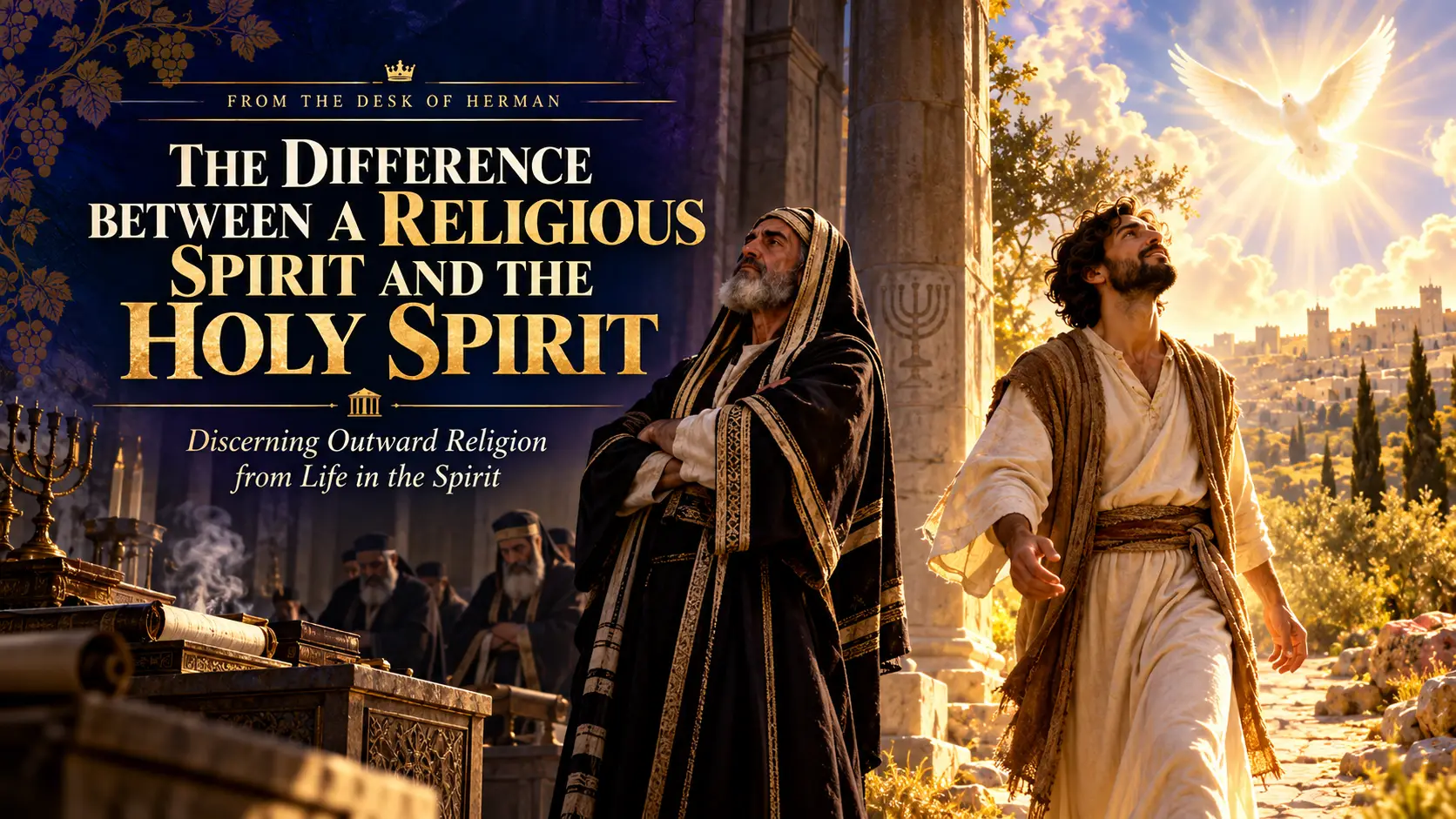
From the Desk of Herman — Part 3 of 6
Discerning Outward Religion from Life in the Spirit
Not everything that appears spiritual proceeds from the same source. Scripture calls believers to distinguish outward religious form from the inward life and transforming work of the Holy Spirit, while avoiding careless labels and preserving sound doctrine, order and accountability.
Foundational Definitions
What Is Meant by a Religious Spirit
In this teaching, a religious spirit refers to a settled pattern that uses religious language, activity, knowledge, or structure while resisting the inward rule of God. It preserves appearance without surrender, seeks acceptance through performance, protects position through control, and measures people by human standards. It may operate as a fleshly mindset, become embedded in a group culture, or be strengthened by spiritual deception. Scripture requires discernment before any conclusion is made.
2 Timothy 3:5 “Having a form of godliness but denying its power. Turn away from such as these.”
The problem is not devotion, doctrine, liturgy, discipline, leadership, or tradition in themselves. James speaks positively of pure and undefiled religion that cares for the vulnerable and remains unstained by the world (James 1:27). Paul commands believers to hold firmly to apostolic teaching (2 Thessalonians 2:15). The problem begins when a practice replaces obedience, when a tradition cancels Scripture, when discipline becomes a means of earning acceptance, or when leadership turns into control.
Who Is the Holy Spirit
The Holy Spirit is not a mood, an atmosphere, an impersonal force, or merely a spiritual influence. He is the eternal Spirit of God. He speaks, teaches, leads, wills, searches, can be grieved, and distributes gifts according to His will (John 14:26; Acts 13:2; Romans 8:14 and 27; Ephesians 4:30; 1 Corinthians 12:11). Peter’s words to Ananias identify lying to the Holy Spirit as lying to God (Acts 5:3 to 4).
The Spirit’s ministry is centred on Christ. He reveals the truth, glorifies Jesus, applies the saving work of Christ, gives new birth, indwells believers, transforms character, empowers witness, and builds the body of Christ (John 3:5 to 8; 16:13 to 14; Romans 8:9 to 11; 1 Corinthians 12:4 to 13; 2 Corinthians 3:18; Acts 1:8).
Three Possible Levels of Operation
A fleshly mindset A believer may attempt to complete by human effort what God began by the Spirit. Paul confronted this in Galatians 3:1 to 3. Pride, fear, insecurity, and the desire for approval can all feed religious performance.
A religious culture Repeated habits can become a system in which appearance, rank, vocabulary, or conformity receives more attention than truth, mercy, holiness, and transformation. Jesus confronted such a culture in Matthew 23.
Spiritual deception Scripture warns of deceiving spirits and doctrines of demons, and commands believers to test the spirits (1 Timothy 4:1; 1 John 4:1). Spiritual influence should not be assumed in every case, but neither should it be ignored when deception persists.
The response should fit the evidence. Flesh requires repentance and renewed thinking. An unhealthy culture requires truthful teaching, accountable leadership, and repaired practices. Demonic oppression requires prayer and spiritual authority under Christ. In every case, freedom rests on the gospel, truth, repentance, and the work of the Holy Spirit.
Essential Safeguards for Discernment
Do not confuse order with religion The Holy Spirit is not the author of disorder. Scripture commands that worship be conducted properly and in an orderly manner (1 Corinthians 14:33 and 40).
Do not confuse emotion with the Spirit Strong feelings, tears, noise, silence, or spontaneity do not prove or disprove His presence. The work must be tested by truth, fruit, and obedience (1 John 4:1; 1 Thessalonians 5:19 to 22).
Do not confuse doctrine with deadness The Spirit inspired Scripture and leads believers into truth. Sound doctrine protects the church, but knowledge becomes distorted when it produces pride without love and obedience (John 16:13; 1 Corinthians 8:1 to 3).
Do not confuse freedom with lawlessness The Spirit frees believers from condemnation and slavery to sin. He does not free them to indulge the flesh (Romans 8:1 to 4; Galatians 5:13 and 16).
Do not confuse questions with rebellion The Bereans examined teaching by Scripture. Honest questions and evidence-based correction can protect truth (Acts 17:11; Galatians 2:11 to 14).
Do not diagnose by labels alone A religious spirit should not be inferred from clothing, worship style, denomination, age, personality, or one disagreement. Jesus taught that a tree is known by its fruit (Matthew 7:16 to 20).
Keep Christ as the final centre Leaders are stewards, Scripture is the final standard, and the Holy Spirit glorifies Jesus rather than a personality, institution, or movement (John 16:14; 1 Corinthians 3:5 to 7).
How a Religious Mindset Develops
Religious bondage often begins with insecurity rather than deliberate hypocrisy. A person who does not rest in the Father’s acceptance may try to secure identity through performance. Performance then produces comparison. Comparison produces pride when the person appears successful and shame when the person falls short. Pride and shame both encourage concealment. Concealment requires control, and control resists any truth or work of God that threatens the image being protected.
Characteristics of a Religious Spirit
Outward Form Without Inward Transformation
Matthew 23:27 to 28 “You are like whitewashed tombs, which look beautiful on the outside, but on the inside are full of dead men’s bones and every kind of impurity. In the same way, on the outside you appear to be righteous, but on the inside you are full of hypocrisy and wickedness.”
A religious spirit concentrates on what can be seen and approved by others. Correct vocabulary, attendance, dress, position, giving, or public ministry can become substitutes for humility, purity, forgiveness, and love. Jesus did not condemn visible obedience. He condemned the separation of visible obedience from the condition of the heart.
Human Tradition Above the Word of God
Mark 7:8 and 13 “You have disregarded the commandment of God to keep the tradition of men… Thus you nullify the word of God by the tradition you have handed down.”
Traditions can preserve wisdom, identity, and order, but they must remain servants of truth. The religious mindset treats familiar practice as though God Himself commanded it. It may resist biblical correction because change feels like betrayal of the group, the leader, or the past. Jesus tested tradition by the revealed will of God and exposed any practice that cancelled obedience.
Self Righteousness and Comparison
In Luke 18:9 to 14, the Pharisee prayed about his own moral record and compared himself with the tax collector. The tax collector asked for mercy. Jesus said that the humbled man went home justified. Self-righteousness needs someone else to appear worse because identity is being built on relative performance rather than the righteousness of Christ (Philippians 3:4 to 9).
Comparison also makes it difficult to rejoice when God blesses people outside our circle. The disciples once tried to stop a man casting out demons because he did not follow with them, but Jesus corrected their exclusiveness (Mark 9:38 to 40). The Spirit-led life recognises the work of Christ without surrendering discernment.
Acceptance Based on Performance
Galatians 3:3 “Are you so foolish? After starting in the Spirit, are you now finishing in the flesh?”
Legalism does more than value obedience. It treats obedience, religious observance, or group conformity as the basis of acceptance before God. The gospel declares that sinners are justified by grace through faith in Christ, not by works of law (Romans 3:20 to 24; Galatians 2:16). Grace then trains believers to reject ungodliness and live upright lives (Titus 2:11 to 14). Obedience is the fruit of salvation, not the price paid to earn it.
Knowledge Without Communion With Christ
John 5:39 to 40 “You pore over the Scriptures because you presume that by them you possess eternal life. These are the very words that testify about Me, yet you refuse to come to Me to have life.”
Biblical study is essential, but the purpose of Scripture is to reveal God and bring people under His rule. A religious spirit can master information while refusing the Christ to whom the text points. It uses truth to establish superiority, win arguments, or control others. The Holy Spirit opens the Word so that people see Christ, repent, believe, obey, and become like Him (Luke 24:27 and 45; 2 Corinthians 3:18).
The Desire for Human Approval
Jesus warned against practising righteousness in order to be seen by others. Giving, prayer, and fasting can all be redirected from communion with God toward reputation (Matthew 6:1 to 18). Some leaders believed in Jesus but would not confess Him because they loved human praise more than praise from God (John 12:42 to 43). A religious spirit adjusts outward behaviour to the audience while leaving the private life unguarded.
Burdening and Controlling People
Matthew 23:4 “They tie up heavy, burdensome loads and lay them on men’s shoulders, but they themselves are not willing to lift a finger to move them.”
Religious control adds demands God has not imposed, treats personal preference as divine law, and uses fear, shame, access, or position to force compliance. At the Jerusalem Council, Peter refused to place on Gentile believers a yoke that neither their fathers nor they had been able to bear. Salvation rests on the grace of the Lord Jesus (Acts 15:7 to 11). Biblical leadership equips the saints; it does not keep people spiritually dependent on the leader (Ephesians 4:11 to 16).
Condemnation Without Redemptive Purpose
A religious spirit exposes failure to shame, rank, or exclude. It may speak generally and repeatedly about unworthiness without identifying a truthful path of repentance. The Holy Spirit convicts concerning sin, righteousness, and judgment (John 16:8). His conviction is specific, truthful, and directed toward repentance and restored fellowship. There is no condemnation for those who are in Christ Jesus, yet the same Spirit actively puts sinful deeds to death (Romans 8:1 and 13).
Neglect of Justice Mercy and Faithfulness
Matthew 23:23 “Woe to you, scribes and Pharisees, you hypocrites! You pay tithes of mint, dill, and cumin. But you have disregarded the weightier matters of the law: justice, mercy, and faithfulness. You should have practiced the latter, without neglecting the former.”
Jesus did not set careful obedience against mercy. He required both, while giving proper weight to the matters that reveal God’s heart. A religious spirit may be exact about minor observances while tolerating cruelty, prejudice, exploitation, dishonesty, or neglect. The Holy Spirit forms righteousness that loves God and neighbour in practical ways (Romans 13:8 to 10; James 2:13).
Resistance to the Present Work of God
When Jesus healed on the Sabbath, some leaders valued their interpretation of the rule above the restoration of the person (Luke 13:10 to 17; John 5:8 to 18). When the Spirit confronted the council through Stephen, he described them as always resisting the Holy Spirit, as their fathers had done (Acts 7:51). Religious systems become dangerous when preserving authority, custom, or reputation matters more than recognising truth and the fruit of God’s work.
Self Made Severity Without Power Over Sin
Colossians 2:20 to 23 describes regulations, self-imposed worship, false humility, and harsh treatment of the body that possess an appearance of wisdom but lack power against fleshly indulgence. Human restriction may manage appearances for a time, but only the Spirit changes desire at its root. Biblical self-control is fruit produced by the Spirit, not a performance used to establish spiritual superiority (Galatians 5:22 to 23).
Biblical Examples of Religious Bondage
The Pharisees and Teachers of the Law
Matthew 23 and Mark 7 show leaders who knew Scripture, practised visible devotion, and occupied respected seats, yet were corrected for hypocrisy, pride, burdening people, love of recognition, and traditions that nullified God’s Word. Their example proves that theological knowledge and public ministry do not guarantee inward surrender. Jesus called them back to truth in the heart, justice, mercy, faithfulness, and humble service.
The Pharisee and the Tax Collector
Luke 18:9 to 14 exposes religion built on comparison. The Pharisee’s prayer was a report of his own superiority. The tax collector stood at a distance, acknowledged his sin, and appealed to God’s mercy. The one who humbled himself was justified. The gospel closes the door to boasting because righteousness is received through Christ (Ephesians 2:8 to 9).
The Older Brother
In Luke 15:25 to 32, the older brother had remained in the father’s house and served for years, but resentment revealed that he related to the father as a worker seeking reward rather than as a son sharing the father’s heart. He could not rejoice over restoration. Religious performance often obeys outwardly while keeping an inward account of what God and others supposedly owe. Sonship receives the father’s love and learns to celebrate grace.
The Galatian Churches
The Galatians had received the Spirit by hearing with faith, but teachers were pressing them toward reliance on works of law and circumcision (Galatians 3:1 to 5; 5:1 to 6). Paul did not oppose holiness. He opposed any system that made human observance the ground of justification or confidence. He called believers to stand in Christ’s freedom and then to walk by the Spirit so that freedom would not become an opportunity for the flesh (Galatians 5:13 to 16).
Saul the Pharisee
Before encountering Christ, Saul was zealous for ancestral traditions and confident in his religious credentials, yet he persecuted the Church (Galatians 1:13 to 14; Philippians 3:4 to 6). After seeing Christ, he counted those credentials as loss compared with knowing Him and receiving righteousness through faith (Philippians 3:7 to 9). Zeal must be governed by revelation, truth, and the Spirit of Christ.
The Character and Work of the Holy Spirit
He Reveals and Glorifies Jesus Christ
John 16:13 to 14 “When the Spirit of truth comes, He will guide you into all truth… He will glorify Me by taking from what is Mine and disclosing it to you.”
The clearest mark of the Spirit’s ministry is the faithful revelation and exaltation of Jesus Christ. He does not build a cult around an experience, a gift, a leader, or Himself. He makes the person and work of Christ known and brings believers into obedient relationship with Him (1 Corinthians 12:3).
He Gives New Birth and Indwells the Believer
Jesus taught that entrance into God’s Kingdom requires birth by the Spirit (John 3:5 to 8). The Spirit does not merely improve an old religious identity. He gives new life and makes the believer God’s dwelling place (Romans 8:9 to 11; 1 Corinthians 6:19). This inward presence produces relationship, not mere external compliance.
He Establishes Sonship Rather Than Slavery
The Spirit leads the sons of God and bears witness that they are God’s children (Romans 8:14 to 16). Religious fear says that one failure will remove all acceptance or that a human authority controls access to God. The Spirit of adoption anchors the believer in the Father through Christ. Secure sons can obey, receive correction, repent, and serve without using performance to prove their worth.
He Leads Into Truth and Obedience
The Spirit of truth never competes with Scripture. He inspired the prophetic Word, reminds believers of Christ’s teaching, and illuminates truth for obedient living (John 14:26; 16:13; 2 Peter 1:20 to 21). A claim of spiritual leading that contradicts the character of Christ or the clear teaching of Scripture must be rejected.
He Convicts and Restores
The Holy Spirit exposes sin so that it can be confessed and forsaken. Godly sorrow produces repentance leading to salvation without regret, while worldly sorrow produces death (2 Corinthians 7:9 to 10). His conviction does not flatter, but neither does it imprison a repentant believer in permanent shame. He applies the cleansing available through Christ and restores truthful fellowship (1 John 1:7 to 9).
He Transforms Character
Galatians 5:22 to 23 “But the fruit of the Spirit is love, joy, peace, patience, kindness, goodness, faithfulness, gentleness, and self-control. Against such things there is no law.”
Gifts can be visible in a moment, but fruit reveals what has been formed over time. The Spirit transforms believers into the image of Christ as they behold the Lord (2 Corinthians 3:18). True spirituality therefore appears in relationships, speech, use of power, handling of money, response to correction, and treatment of vulnerable people.
He Gives Holy Freedom
2 Corinthians 3:17 “Now the Lord is the Spirit, and where the Spirit of the Lord is, there is freedom.”
The Spirit frees people from condemnation, slavery to sin, fear, and reliance on the flesh. This freedom is the ability to love and obey God from a renewed heart. It is not independence from Christ, Scripture, or the body. Believers are called to use freedom to serve one another in love (Galatians 5:13).
He Empowers Witness and Service
The Spirit gives power to bear witness to Christ and distributes gifts for the common good (Acts 1:8; 1 Corinthians 12:4 to 11). Religious ambition uses ministry to establish importance. The Holy Spirit empowers each member to serve so that the whole body is built up. Gifts remain under love, truth, accountability, and order (1 Corinthians 13; 14:26 to 33).
He Produces Unity Without Uniformity
There is one Spirit and one body, yet the Spirit gives different gifts and functions (Ephesians 4:3 to 6; 1 Corinthians 12:12 to 20). Religious systems may demand sameness or divide people around secondary markers. The Spirit creates unity in Christ while preserving genuine diversity of grace, culture, maturity, and calling.
A Direct Comparison
Conviction and Condemnation
Many believers struggle to distinguish the Holy Spirit’s conviction from religious condemnation. Both may make a person aware that something is wrong, but their nature and fruit differ. Conviction agrees with Scripture, identifies the matter truthfully, and draws the person toward confession, repentance, cleansing, and restored obedience. Condemnation attacks identity, speaks in hopeless absolutes, keeps the matter vague or endlessly repeated, and drives the person toward hiding, despair, or frantic performance.
Romans 8:1 declares that there is no condemnation for those who are in Christ Jesus. This does not make sin unimportant. The same chapter teaches believers to put the deeds of the body to death by the Spirit (Romans 8:13). Grace removes the sentence of condemnation and supplies power for a changed life.
Tests for Discerning the Source
1. The Scripture test. Does the teaching or practice agree with the whole counsel of God, or does it depend on isolated verses, private revelation, or human tradition that cancels clear Scripture (Acts 17:11; Mark 7:13)?
2. The Christ test. Does it confess and glorify Jesus as Lord, make His cross and resurrection central, and lead people into obedience to Him (John 16:14; 1 Corinthians 12:3)?
3. The gospel test. Does it rest acceptance on the grace of God through faith, or require human performance, group membership, or loyalty to a personality as an additional basis of righteousness (Galatians 2:16; Ephesians 2:8 to 10)?
4. The fruit test. Does the long-term outcome display the fruit of the Spirit, or fear, pride, rivalry, concealment, manipulation, and bondage (Galatians 5:19 to 23; Matthew 7:16)?
5. The holiness test. Does the claimed freedom lead to loving obedience and victory over sinful desires, or does it excuse the flesh (Romans 8:4; Galatians 5:13 and 16)?
6. The love test. Are truth, justice, mercy, patience, and care for people present, especially toward the weak and those who cannot advance the leader’s interests (1 Corinthians 13:1 to 7; James 1:27)?
7. The freedom and order test. Are people released to mature under Christ while remaining accountable to Scripture and the body, or are they controlled on one side or lawless on the other (2 Corinthians 3:17; 1 Corinthians 14:40)?
8. The humility test. Can the person or leadership receive questions, submit to examination, confess error, and change, or must the image and system always be defended (James 3:13 to 17)?
9. The body test. Are gifts used for the common good and the equipping of the saints, or to gather a dependent private following (1 Corinthians 12:7; Ephesians 4:11 to 16)?
How to Overcome a Religious Spirit
1. Come to Christ Himself. Refuse to make knowledge, activity, tradition, position, or a human leader the source of life. Receive life through union with Jesus Christ (John 5:39 to 40; Colossians 2:6 to 10).
2. Repent specifically. Name self-righteousness, pride, hypocrisy, fear of people, control, comparison, judgment, and any use of religion for personal advantage. God gives grace to the humble (James 4:6 to 10).
3. Receive justification by faith. Settle the foundation of acceptance in the finished work of Christ. Good works follow salvation; they do not purchase it (Romans 3:22 to 24; Ephesians 2:8 to 10).
4. Receive the Spirit of sonship. Reject the orphaned need to prove identity through position, visibility, or flawless performance. Let the Spirit establish the cry of Abba Father within you (Romans 8:15 to 17; Galatians 4:4 to 7).
5. Renew the mind through Scripture. Replace inherited assumptions, false standards, and condemning narratives with truth understood in context and obeyed from the heart (Romans 12:2; 2 Timothy 3:16 to 17).
6. Walk by the Spirit daily. Depend on the Spirit in prayer, decision, speech, relationships, and resistance to sinful desire. Keep in step with Him rather than returning to self-effort (Galatians 5:16 and 25).
7. Bring the hidden life into the light. Practise confession, honest accountability, and private devotion before God. What is done in secret should agree with what is presented publicly (Matthew 6:1 to 18; 1 John 1:7 to 9).
8. Submit every tradition and experience to Scripture. Keep practices that serve truth and love. Correct or release practices that bind consciences where God has not spoken (Mark 7:8 to 13; Romans 14:1 to 13).
9. Practise justice mercy and faithfulness. Care for people, repair wrongs, forgive, give generously, and treat the vulnerable with dignity. These actions expose religion that exists only in words (Matthew 23:23; James 2:14 to 17).
10. Receive correction without self-protection. Ask trusted mature believers to identify blind spots. Test what is said by Scripture and respond humbly to truth (Proverbs 12:1; Galatians 6:1 to 2).
11. Serve without seeking recognition. Choose the lower place, develop others, and allow God to determine visibility and enlargement (Mark 10:42 to 45; 1 Peter 5:5 to 6).
12. Ask continually for the filling of the Spirit. Yield every area of life to His rule and let worship, gratitude, truth, and mutual submission shape the household (Luke 11:13; Ephesians 5:18 to 21).
Dealing With Religious Patterns in a Spiritual House
A house cannot overcome religious control merely by using different language or adopting a more expressive worship style. A system can remain controlling while appearing modern, informal, prophetic, or charismatic. Leaders must examine the culture, use of authority, treatment of questions, financial practices, access to correction, response to failure, and the fruit being formed in people.
Teach grace and holiness together Grace saves and trains believers to reject ungodliness. Holiness is neither a human payment for acceptance nor an optional response to grace (Titus 2:11 to 14).
Keep Scripture open to examination Teaching, prophecy, tradition, and leadership decisions should remain under biblical testing. Mature examination protects truth rather than threatening it (Acts 17:11; 1 Corinthians 14:29).
Correct conduct rather than weaponising labels Describe the observable words, decisions, pressure, concealment, or harm. Do not call someone religious merely because the person is cautious, traditional, quiet, structured, or disagrees.
Let leaders model repentance A leader who can confess error and make repair demonstrates that authority rests under Christ rather than in an untouchable image (1 Peter 5:2 to 3).
Make room for questions and conscience Believers should be taught how to distinguish clear biblical commands from disputable matters and personal preferences (Romans 14:1 to 13).
Restore gently while maintaining boundaries Those who repent should receive patient formation. Persistent manipulation, condemnation, or abuse of authority may require restricted influence until trustworthy fruit is evident (Galatians 6:1; Matthew 3:8).
Protect people from spiritual abuse Honour does not silence truth, covering does not conceal abuse, and submission does not require participation in sin. Crime, abuse, or serious danger must be reported through proper lawful and safeguarding processes (Acts 5:29; Romans 13:1 to 4).
Measure maturity by Christlike fruit Attendance, vocabulary, gifting, visibility, and loyalty cannot replace love, truth, holiness, justice, humility, and faithful service (Galatians 5:22 to 23).
The Spirit Led Builder Son
The Holy Spirit forms sons who build the family and the house of the Father. A builder son does not preserve a religious system for personal security, nor does he use freedom to reject responsibility. He is established in the Father through Christ, receives truth with humility, carries the family in his heart, and strengthens others toward maturity.
He builds from sonship rather than slavery His service flows from belonging and gratitude, not fear of rejection or the need to earn identity (Romans 8:14 to 17).
He honours without idolising He recognises grace and delegated responsibility while keeping Christ as Head and Scripture as the final authority (1 Corinthians 11:1; Colossians 1:18).
He handles truth to form people He does not use Scripture to display superiority or secure control. He teaches so that people can know Christ, obey truth, and become mature (2 Timothy 2:15; Ephesians 4:13 to 15).
He carries grace and truth together He does not excuse sin in the name of love or crush people in the name of holiness. He seeks repentance, protection, repair, and restoration (John 1:14; Galatians 6:1).
He equips rather than creates dependence He gives responsibility, develops gifts, and connects people to Christ and the whole body instead of gathering a private following (Ephesians 4:11 to 16).
He protects the house from both control and lawlessness He values freedom, order, accountability, and the diverse work of the Spirit (Galatians 5:13; 1 Corinthians 12:4 to 7).
He demonstrates the Father’s heart He practises justice, mercy, faithfulness, patience, and truthful correction. His authority is recognised through character and service (Matthew 23:23; Mark 10:43 to 45).
A true son is therefore a builder of the family and the house of the father. He does not build an institution that depends on human fear, nor an independent platform centred on himself. He builds people into Christ, protects the household’s integrity, carries shared responsibility, and leaves those he serves more capable of hearing and obeying the Holy Spirit.
Personal Examination
1. Is my confidence before God resting in Christ, or in my religious record, position, knowledge, giving, discipline, or association?
2. Do I obey because I am accepted in Christ, or to earn acceptance and human approval?
3. Have I made a personal preference, tradition, or house culture equal to a biblical command?
4. Do I use Scripture to submit my own life to God, or mainly to correct, rank, and control others?
5. Can I receive correction without defending my image or comparing myself with someone worse?
6. Do I rejoice when God works through people outside my familiar circle?
7. Does my private life agree with the spirituality I present publicly?
8. When someone fails, do I seek truth, repentance, protection, and restoration, or shame and exclusion?
9. Are people becoming mature under Christ through my influence, or increasingly dependent on my approval and interpretation?
10. Does my claimed freedom produce love, holiness, service, and self-control, or excuse fleshly independence?
11. What fruit is consistently visible in my speech, relationships, use of authority, money, and response to disappointment?
12. What religious fear, tradition, comparison, or controlling practice must I now surrender to the Holy Spirit?
Corporate Examination
1. Does our house preach salvation by grace while also forming believers in holy obedience?
2. Can teaching, prophecy, policies, and leadership conduct be tested responsibly by Scripture?
3. Can people ask honest questions without being shamed, threatened, or automatically labelled rebellious?
4. Do our standards distinguish clear biblical commands from preferences, traditions, and disputable matters?
5. Do leaders remain accountable, correctable, transparent, and willing to make restitution?
6. Are we more concerned with public image and numerical loyalty than inward transformation and mature discipleship?
7. Does correction lead toward repentance and restoration, or produce fear, dependence, and concealment?
8. Are gifts and ministries used for the common good, or to establish status and private followings?
9. Do justice, mercy, care for the vulnerable, and truthful safeguarding have a visible place in our culture?
10. Are sons and daughters being equipped to hear God, handle Scripture faithfully, carry responsibility, and build the family?
Teaching Summary
The phrase religious spirit is not a formal biblical title and must be defined by biblical patterns rather than used as a careless accusation.
A religious spirit preserves outward form while resisting inward transformation, grace, truth, mercy, and the present rule of God.
The Holy Spirit is God, a divine Person who reveals Christ, gives new birth, establishes sonship, leads into truth, convicts, transforms, empowers, and builds the body.
Sound doctrine, spiritual order, discipline, and faithful traditions are not enemies of the Spirit when they remain under Scripture and serve Christlike life.
Freedom in the Spirit is freedom from condemnation and sinful slavery so that believers can love, obey, serve, and mature.
The clearest tests are agreement with Scripture, the exaltation of Christ, the gospel of grace, holy fruit, love, humility, accountability, and the building of the body.
Religious bondage is overcome through repentance, faith in Christ, sonship, renewed thinking, daily dependence on the Spirit, honest community, and sustained fruit.
A Spirit-led son becomes a builder of the family and the house of the father, equipping people toward maturity without creating fear or dependence.
Closing Declaration and Prayer
Father, we come to You through Jesus Christ and not through confidence in our own works. Search our hearts and expose every form of pride, hypocrisy, fear, comparison, self-righteousness, control, and dependence on human approval. Forgive us for every occasion on which we have used truth to exalt ourselves, tradition to cancel obedience, authority to burden people, or freedom to serve the flesh.
Lord Jesus, remain the centre and Head of Your Church. Deliver us from knowing Scripture without coming to You for life. Establish us in the finished work of the cross and the power of Your resurrection. Teach us to obey from love and acceptance rather than from slavery and fear.
Holy Spirit, fill us afresh. Lead us into truth, convict us where repentance is required, and form the character of Christ within us. Produce love, joy, peace, patience, kindness, goodness, faithfulness, gentleness, and self-control. Give us gifts that serve the common good and wisdom to exercise them in love and order.
Make our spiritual households places of grace and truth. Give leaders humility, courage, accountability, and the heart of servants. Give sons and daughters secure identity, teachable hearts, discernment, and faithful hands. Protect us from both controlling religion and lawless independence. Teach us to build people into Christ and to strengthen the family and house entrusted to us.
Where religious bondage has produced fear, shame, concealment, division, or spiritual dependence, bring light and freedom. Restore those who have been wounded, correct those who have misused authority, and establish practices that honour Scripture, protect people, and reveal the heart of the Father.
In the name of Jesus Christ. Amen.
Primary Scripture References
Mark 7:1 to 13; Matthew 6:1 to 18; Matthew 23; Luke 15:25 to 32; Luke 18:9 to 14; John 3:5 to 8; John 5:39 to 40; John 14:16 to 26; John 16:7 to 15; Acts 5:3 to 4; Acts 7:51; Acts 15:1 to 29; Romans 3:20 to 24; Romans 8:1 to 17; 1 Corinthians 12 to 14; 2 Corinthians 3:3 to 18; Galatians 2:16; Galatians 3:1 to 5; Galatians 5:1 to 26; Ephesians 2:8 to 10; Ephesians 4:1 to 16; Colossians 2:6 to 23; 1 Timothy 4:1; 2 Timothy 3:1 to 5; Titus 2:11 to 14; James 1:22 to 27; 1 John 4:1 to 6.
Series: From the Desk of Herman — Father and Son Wineskin Teaching Series, Part 3 of 6.
Unless otherwise indicated, Scripture quotations are from the Berean Standard Bible (BSB).
Herman Bouwer
777th Precinct Ministries