WALKING FREE FROM DAMAGED MINDSETS – STEPS OF TRUTH, REPENTANCE, RENEWAL, OBEDIENCE, AND IDENTITY IN CHRIST
INTRODUCTION TO DAMAGED MINDSETS
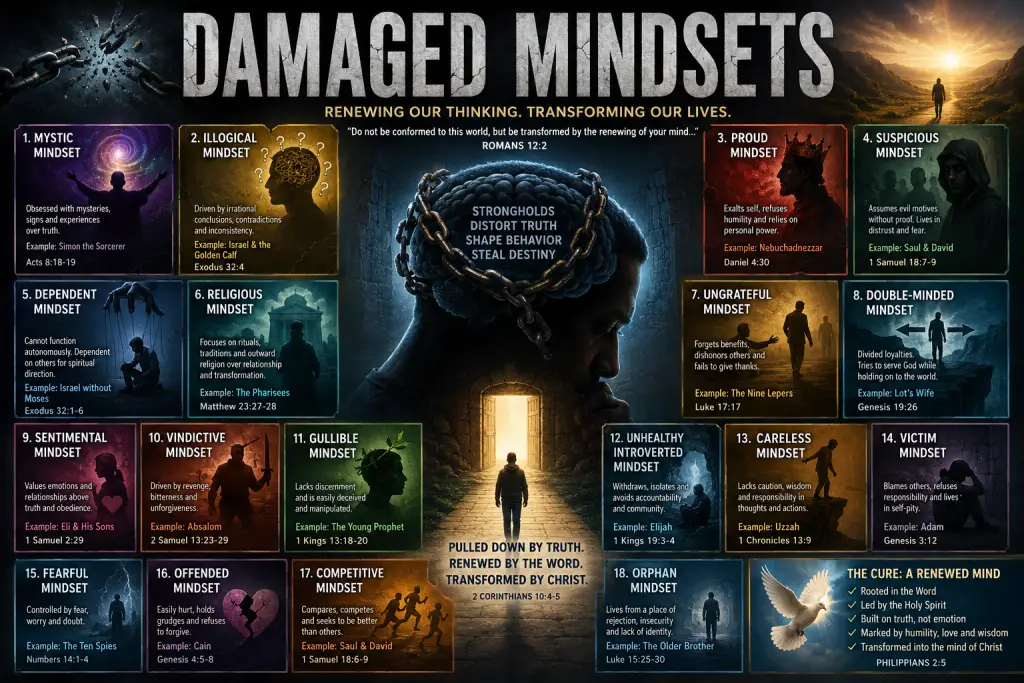
We have spent nineteen chapters dissecting the intricate architecture of damaged mindsets and of self-sabotage. We have uncovered how deeply entrenched mentalities of the damaged mindsets isolate us, choke out our potential, corrupt our relationships, distort our identity, and keep us running in circles. We have examined mindsets rooted in fear, pride, suspicion, rejection, insecurity, competition, offense, double-mindedness, carelessness, gullibility, independence, and other forms of internal brokenness.
But understanding the anatomy of a damaged mindset is only half the battle. You cannot merely study the bars of your cage; you must choose to unlock the door. You cannot only describe your prison; you must walk out of it. You cannot only identify the mindset that has kept you bound; you must submit that mindset to the Lordship of Christ and allow the Word of God to rebuild the inner man.
Many people become experts in explaining their bondage but remain strangers to freedom. They know what happened to them, who wounded them, what they fear, why they withdraw, and how their patterns developed. Yet knowledge without transformation can become another form of bondage. Revelation must lead to repentance. Repentance must lead to renewal. Renewal must lead to obedience. Obedience must lead to a settled identity in Christ.
Scripture reminds us that believers are not helpless victims of automatic, toxic thoughts. We are not called to live as slaves to fear, shame, rejection, bitterness, insecurity, or defeat.
2 Timothy 1:7 NKJV
(7) For God has not given us a spirit of fear, but of power and of love and of a sound mind.
This verse is foundational. God has not given us a spirit of fear. Fear may attack us, but it does not come from God. Torment may knock on the door of the mind, but it is not our inheritance in Christ. Confusion may try to dominate our thoughts, but God has made provision for a sound mind.
A sound mind is a disciplined mind, a healed mind, a renewed mind, a Spirit-governed mind, and a truth-aligned mind. It is not a mind that has never experienced pain. It is a mind that has been brought under the government of Christ.
True, lasting liberation from self-sabotaging patterns does not come from temporary willpower, emotional hype, motivational slogans, or secular self-help alone. These may provide temporary encouragement, but they cannot deliver the soul from deep spiritual bondage. Freedom requires a supernatural overhaul. It requires the truth of God’s Word, the conviction of the Holy Spirit, genuine repentance, the renewing of the mind, and a lifestyle of obedience.
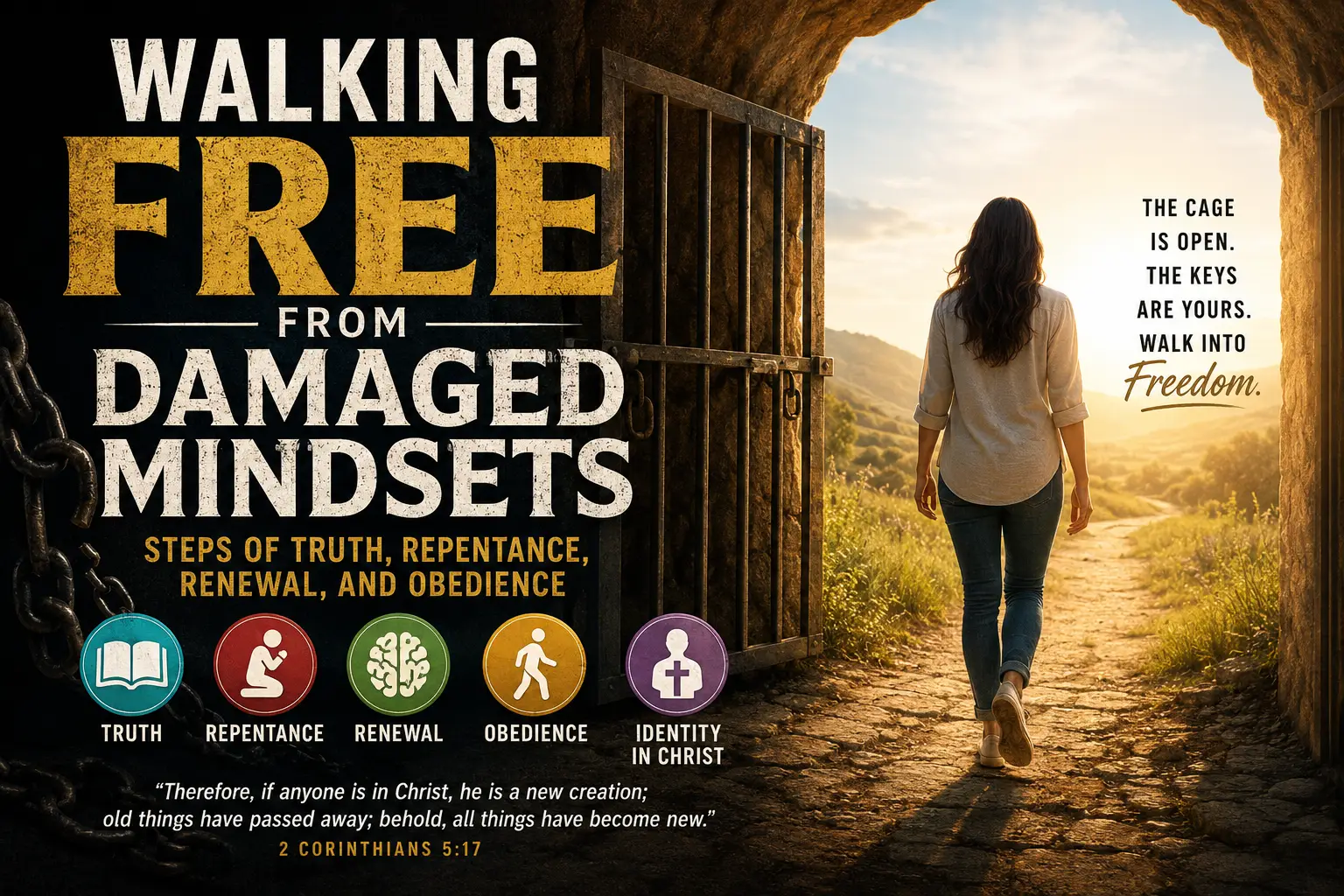
To permanently break the cycle of damaged mindsets, we must actively engage in a biblical framework:
- Truth — confronting the lie
- Repentance — turning from the pattern
- Renewal — rewiring the mind through the Word
- Obedience — cementing freedom through action
- Identity in Christ — living from the new man
This is a practical, scriptural blueprint for walking out of the cage of self-sabotage and into the abundant life Christ has promised.
John 10:10 NKJV
(10) The thief does not come except to steal, and to kill, and to destroy. I have come that they may have life, and that they may have it more abundantly.
Self-sabotage steals. Damaged mindsets destroy. Old patterns kill momentum, purpose, confidence, intimacy, obedience, and destiny. But Christ came to restore life. He came not only to forgive sin, but to liberate the whole person — spirit, soul, body, relationships, purpose, and future.
STEP 1: TRUTH — THE DIAGNOSIS
Freedom always begins with radical honesty. Self-sabotage survives in darkness. It feeds on hidden lies, half-truths, false assumptions, emotional conclusions, and internal scripts that have never been brought under the authority of God’s Word.
A damaged mindset is often built around a lie that has been repeated until it feels like truth. The longer a person rehearses a lie, the more familiar it becomes. Familiarity then disguises bondage as personality.
For example, someone may say:
- “I am just naturally suspicious.”
- “I am just an angry person.”
- “I have always been insecure.”
- “I cannot help being controlling.”
- “I am not good with people.”
- “I always fail.”
- “I will never be accepted.”
- “Nobody can be trusted.”
- “God uses others, but not me.”
These statements may feel true because they are rooted in pain, memory, disappointment, trauma, rejection, or repeated failure. But feeling real does not make something true. A damaged mindset often confuses emotional intensity with spiritual accuracy.
Truth is not determined by what wounded you. Truth is not determined by what people said about you. Truth is not determined by your worst season, your deepest failure, your family background, your personality weakness, or your history of rejection. Truth is determined by God.
The Biblical Principle of Truth
John 8:32 NKJV
(32) And you shall know the truth, and the truth shall make you free.”
Jesus did not say that denial would make us free. He did not say that time alone would make us free. He did not say that positive thinking would make us free. He said truth makes us free.
But this truth is not merely information. Biblical truth is living, authoritative, redemptive, and liberating. Truth is found in Christ and revealed through His Word.
John 14:6 NKJV
(6) Jesus said to him, “I am the way, the truth, and the life. No one comes to the Father except through Me.
Truth is not only a principle; Truth is a Person. When Christ confronts the lie, the lie loses its authority. When the Word of God enters the inner man, darkness is exposed. When truth becomes stronger than pain, freedom begins.
We Need to Be Delivered from the Bondage of the Past
Many damaged mindsets are not born in the present. They are rooted in the past. A person may be physically living in today while emotionally reacting from yesterday. They may be saved, gifted, called, and loved by God, yet still governed by old wounds, old fears, old betrayals, old rejection, old shame, or old survival mechanisms.
This is why truth must go deeper than surface behavior. Truth must confront the roots.
Jesus spoke directly about freedom from bondage.
John 8:34-36 NKJV
(34) Jesus answered them, “Most assuredly, I say to you, whoever commits sin is a slave of sin.
(35) And a slave does not abide in the house forever, but a son abides forever.
(36) Therefore if the Son makes you free, you shall be free indeed.
The people Jesus addressed claimed that they had never been in bondage. Yet their denial did not change their condition. This is one of the dangers of damaged mindsets: people can be bound and still insist they are free. They can be controlled by fear and call it wisdom. They can be driven by pride and call it excellence. They can be governed by suspicion and call it discernment. They can be trapped in independence and call it strength.
Jesus exposes bondage so that He can bring freedom. His goal is not shame; His goal is deliverance.
The Son does not merely improve the prison. He opens the door.
“Therefore if the Son makes you free, you shall be free indeed.”
Freedom in Christ is not partial freedom. It is not religious appearance while the inner man remains chained. It is freedom indeed — freedom in the heart, freedom in the conscience, freedom in the mind, freedom from sin’s dominion, freedom from the old man, and freedom to live as a son in the Father’s house.
Putting Off the Old Man
The apostle Paul gives us a clear picture of how freedom must affect our inner life.
Ephesians 4:22-24 NKJV
(22) that you put off, concerning your former conduct, the old man which grows corrupt according to the deceitful lusts,
(23) and be renewed in the spirit of your mind,
(24) and that you put on the new man which was created according to God, in true righteousness and holiness.
STEP 2: REPENTANCE — THE PIVOT
Truth exposes the lie, but repentance breaks agreement with it. Once the light of God’s Word reveals the damaged mindset, the next step is not merely to feel sorry, become emotional, or make excuses. The next step is repentance.
Many people treat damaged mindsets as unfortunate personality traits, emotional weaknesses, family patterns, or unchangeable flaws. They say things like, “This is just how I am,” “I have always been like this,” “My family made me this way,” or “I cannot help it because of what happened to me.” While our past may explain some of our struggles, it must never become the excuse that keeps us bound.
A damaged mindset may have been formed through pain, rejection, betrayal, trauma, disappointment, or wrong teaching, but once God reveals it, we become responsible for how we respond to it. Revelation brings responsibility. When the Holy Spirit exposes a pattern, He is inviting us into freedom.
Repentance is the pivot point where we stop defending the old pattern and begin turning toward God’s way of thinking.
What Is Repentance?
The word repentance speaks of a change of mind, a change of direction, and a change of alignment. It is not merely regret. Regret says, “I feel bad because of the consequences.” Repentance says, “I agree with God, I turn from the old way, and I choose a new direction.”
Repentance is not shame. Shame drives us away from God. Repentance brings us back to God. Shame says, “I am too dirty to come near.” Repentance says, “Father, I am coming home.” Shame hides. Repentance confesses. Shame agrees with condemnation. Repentance agrees with truth.
A person can cry and still not repent. A person can feel guilty and still not change direction. A person can admit they have a problem and still protect the pattern. True repentance involves surrendering the inner agreement we have made with the damaged mindset.
For example:
- Fear must be repented of when it becomes unbelief.
- Pride must be repented of when it refuses correction.
- Bitterness must be repented of when it resists forgiveness.
- Suspicion must be repented of when it judges motives without truth.
- Independence must be repented of when it rejects covenant relationships and accountability.
- Insecurity must be repented of when it denies our identity in Christ.
- Victim thinking must be repented of when it refuses responsibility and faith.
- Perfectionism must be repented of when it becomes pride, self-reliance, or fear of man.
Repentance is where we stop saying, “This is just my mindset,” and begin saying, “Lord, I renounce this agreement because it is not from You.”
The Biblical Principle
Acts 3:19 NKJV
(19) Repent therefore and be converted, that your sins may be blotted out, so that times of refreshing may come from the presence of the Lord,
This verse gives us a powerful sequence.
First, there is repentance. Then there is conversion, which means a turning or change of direction. Then sins are blotted out. Then times of refreshing come from the presence of the Lord.
Many people want refreshing without repentance. They want peace without surrender. They want healing without exposure. They want freedom without changing direction. But Scripture shows that refreshing follows repentance.
Repentance opens the door for the presence of God to bring restoration, cleansing, healing, and renewal.
Repentance Requires Confession
A damaged mindset must be confessed when it crosses into sin, unbelief, rebellion, pride, bitterness, self-protection, or disobedience. Confession means we stop covering the issue and bring it into the light before God.
1 John 1:9 NKJV
(9) If we confess our sins, He is faithful and just to forgive us our sins and to cleanse us from all unrighteousness.
This is one of the most comforting promises in Scripture. God does not tell us to confess so that He can humiliate us. He invites us to confess so that He can forgive and cleanse us.
Forgiveness deals with guilt. Cleansing deals with contamination. God not only removes the record of sin; He also begins washing the inner life from the effects of sin.
When a person confesses pride, God gives grace for humility. When a person confesses bitterness, God begins restoring tenderness. When a person confesses fear, God strengthens faith. When a person confesses unbelief, God renews trust. When a person confesses self-reliance, God teaches dependence on Him.
Confession breaks secrecy. Secrecy strengthens bondage, but confession opens the door to healing.
James 5:16 NKJV
(16) Confess your trespasses to one another, and pray for one another, that you may be healed. The effective, fervent prayer of a righteous man avails much.
There is confession before God for forgiveness, and there is also wise confession before trusted, mature believers for healing and accountability. Not every person is safe to hear your inner battles, but isolation is also dangerous. Some strongholds lose power when they are brought into godly, prayerful, accountable relationships.
CONFESSION BRINGS FREEDOM IN THE INNER MAN
When confession is genuine, it brings freedom into areas that damaged mindsets have often polluted.
-
Freedom in the Emotions
Unconfessed sin and hidden agreements often create emotional heaviness. A person may feel constantly anxious, angry, defensive, restless, or emotionally numb without understanding why.
Confession brings emotions into the light. It allows the Holy Spirit to begin untangling the inner knots of fear, shame, guilt, resentment, and grief.
David understood the emotional weight of hidden sin.
Psalms 32:3-5 NKJV
(3) When I kept silent, my bones grew old Through my groaning all the day long.
(4) For day and night Your hand was heavy upon me; My vitality was turned into the drought of summer. Selah
(5) I acknowledged my sin to You, And my iniquity I have not hidden. I said, “I will confess my transgressions to the LORD,” And You forgave the iniquity of my sin. Selah
Silence made David weak. Confession brought release. What he covered began to drain him. What he confessed became the place of mercy.
-
Freedom from Guilt Feelings
There is true guilt and false guilt.
True guilt comes when the Holy Spirit convicts us of sin so that we may repent and be restored. False guilt comes from condemnation, accusation, religious pressure, people-pleasing, or shame from the past.
Repentance helps us deal with true guilt through confession and forgiveness. It also helps us reject false guilt by standing in the finished work of Christ.
Romans 8:1 NKJV
(1) There is therefore now no condemnation to those who are in Christ Jesus, who do not walk according to the flesh, but according to the Spirit.
Conviction leads to repentance and life. Condemnation leads to despair and bondage. The Holy Spirit convicts specifically and redemptively. The enemy condemns vaguely and destructively.
-
Freedom from Hardness of Heart
Damaged mindsets can harden the heart. When people are hurt repeatedly, they may build walls around their heart and call it wisdom. They may become cold, cynical, defensive, unteachable, or emotionally unavailable.
But a hardened heart cannot easily receive correction, intimacy, love, healing, or truth.
God’s desire is not only to change our behavior; He wants to soften the heart.
Ezekiel 36:26 NKJV
(26) I will give you a new heart and put a new spirit within you; I will take the heart of stone out of your flesh and give you a heart of flesh.
A heart of stone is resistant. A heart of flesh is responsive. Repentance allows God to remove the stony places created by pain, pride, rebellion, or self-protection.
-
Freedom from Bitterness
Bitterness is one of the most destructive roots behind damaged mindsets. It poisons perception. It causes people to interpret everything through offense. It makes the heart suspicious, defensive, and easily wounded.
Hebrews 12:15 NKJV
(15) looking carefully lest anyone fall short of the grace of God; lest any root of bitterness springing up cause trouble, and by this many become defiled;
STEP 3: RENEWAL — THE REWIRING
Truth exposes the lie. Repentance breaks agreement with the lie. But renewal replaces the lie with the mind of Christ.
This is a critical step because freedom is not only about what we leave behind; it is also about what we put on. Many people repent sincerely, but they do not renew their minds consistently. As a result, they experience temporary relief but not lasting transformation. They confess the old pattern, cry before God, ask for forgiveness, and genuinely desire change, but then return to the same mental environment that produced the bondage in the first place.
A damaged mindset cannot be permanently broken by emptying the mind. It must be replaced by truth. The old script must be rewritten. The old imagination must be cast down. The old internal conversation must be interrupted by the Word of God. The old pattern of thinking must be displaced by a new spiritual operating system.
Renewal is the process whereby the Word of God reshapes the inner man until our thoughts, emotions, decisions, desires, and reactions come into agreement with the will of God.
The Biblical Principle
Romans 12:2 NKJV
(2) And do not be conformed to this world, but be transformed by the renewing of your mind, that you may prove what is that good and acceptable and perfect will of God.
This verse reveals two opposing forces: conformity and transformation.
To be conformed means to be pressed into the pattern of the world. The world has a mindset. Culture has a mindset. Pain has a mindset. Rejection has a mindset. Fear has a mindset. Pride has a mindset. Offense has a mindset. Self-preservation has a mindset. If we do not intentionally renew our minds, we will unconsciously be shaped by the systems, wounds, voices, and patterns around us.
Transformation, however, comes by the renewing of the mind. God does not only want to change our outward behavior; He wants to change the inner structure from which behavior flows.
A person can modify behavior for a season while the old mindset remains untouched. But when the mind is renewed, behavior begins to change from the inside out.
Renewal Is More Than Information
Biblical renewal is not merely collecting more knowledge. It is not simply reading many verses, listening to many sermons, or memorizing spiritual vocabulary. A person can have information and still remain untransformed.
The Pharisees knew Scripture, yet many of them resisted Christ. They had information, but they lacked transformation. Their minds were religiously informed but not spiritually renewed.
Renewal happens when truth moves from the page into the heart, from the heart into conviction, from conviction into action, and from action into lifestyle.
James 1:21 NKJV
(21) Therefore lay aside all filthiness and overflow of wickedness, and receive with meekness the implanted word, which is able to save your souls.
The Word must be implanted. It must be received with meekness. The soul must be exposed to the living Word until the Word begins to govern thoughts, motives, reactions, speech, choices, and desires.
The soul is the arena of self-sabotage. It is where memories, emotions, reasoning, fears, desires, and decisions operate. Therefore, the soul must be brought under the authority of the implanted Word.
Renewal Requires Putting Off and Putting On
The apostle Paul shows us that transformation involves both removal and replacement.
Ephesians 4:22-24 NKJV
(22) that you put off, concerning your former conduct, the old man which grows corrupt according to the deceitful lusts,
(23) and be renewed in the spirit of your mind,
(24) and that you put on the new man which was created according to God, in true righteousness and holiness.
STEP 4: OBEDIENCE — THE SEALED VICTORY
Truth exposes the lie. Repentance breaks agreement with the lie. Renewal replaces the lie with the Word of God. But obedience is the step that seals the victory in practical daily living.
A renewed mind must become an obedient life. If truth remains only in our thoughts, it can easily become theory. If repentance remains only emotional, it can become temporary relief. If renewal remains only devotional, it can become spiritual information without visible transformation. But obedience takes truth out of the heart and puts it into motion.
Obedience is where freedom becomes visible.
Many believers desire freedom from damaged mindsets, but they remain trapped because they stop short of action. They know the truth. They confess the truth. They even quote the truth. But when the moment of decision arrives, they continue obeying the old mindset.
The fearful mindset still avoids risk.
The offended mindset still withdraws.
The suspicious mindset still accuses.
The proud mindset still refuses correction.
The scarcity mindset still hoards.
The victim mindset still blames.
The orphan mindset still strives for acceptance.
The careless mindset still ignores boundaries.
The competitive mindset still compares.
The double-minded mindset still delays obedience.
This is why obedience is essential. Freedom is not only what you believe; it is what you obey.
The Biblical Principle
James 1:22 NKJV
(22) But be doers of the word, and not hearers only, deceiving yourselves.
This verse is direct and sobering. It is possible to hear the Word and still deceive ourselves. Self-deception happens when we mistake exposure to truth for obedience to truth. We may hear sermons, read Scripture, attend meetings, take notes, and agree with what God says, but if we do not obey, the mindset remains unchanged.
Hearing truth gives us responsibility. Obeying truth brings transformation.
James continues by comparing the hearer-only believer to a person who looks in a mirror and then walks away unchanged.
James 1:23-25 NKJV
(23) For if anyone is a hearer of the word and not a doer, he is like a man observing his natural face in a mirror;
(24) for he observes himself, goes away, and immediately forgets what kind of man he was.
(25) But he who looks into the perfect law of liberty and continues in it, and is not a forgetful hearer but a doer of the work, this one will be blessed in what he does.
The Word of God is a mirror. It shows us who we are, where we are, what must change, and what God has made available. But the blessing is not promised to the person who merely looks. The blessing is promised to the one who continues and becomes a doer.
The “perfect law of liberty” reveals that obedience is not bondage. In the Kingdom of God, obedience is the pathway of freedom. Sin enslaves. Fear enslaves. Pride enslaves. Bitterness enslaves. But obedience to Christ brings liberty.
Obedience Is the Evidence of Love
Obedience is not legalism when it flows from love. Legalism obeys to earn acceptance. Sonship obeys because acceptance has already been received. Legalism tries to impress God. Sonship responds to the love of God. Legalism is driven by fear. Sonship is moved by devotion.
Jesus made the connection between love and obedience very clear.
John 14:15 NKJV
(15) “If you love Me, keep My commandments.
This means obedience is not merely a religious duty; it is the language of love. We do not obey God to become His children. We obey because we are His children. We do not obey to purchase His favor. We obey because His favor has already been given to us in Christ.
A damaged mindset often resists obedience because it does not fully trust the Father. Fear says, “If I obey, I may lose control.” Pride says, “If I obey, I may look weak.” Offense says, “If I obey, they may get away with what they did.” Insecurity says, “If I obey, I may be rejected.” Scarcity says, “If I obey, I may not have enough.”
But love says, “Father, I trust You enough to obey You.”
Obedience Exposes Who Is Really Lord
A mindset is not only revealed by what we think. It is revealed by what we obey. Whatever we consistently obey has functional authority over us.
If fear determines our decisions, fear has become a ruler.
If offense determines our relationships, offense has become a ruler.
If pride determines our responses to correction, pride has become a ruler.
If insecurity determines our identity, insecurity has become a ruler.
If comfort determines our calling, comfort has become a ruler.
Jesus asked a penetrating question:
Luke 6:46 NKJV
(46) “But why do you call Me ‘Lord, Lord,’ and not do the things which I say?
This verse confronts religious confession without surrendered obedience. It is possible to call Jesus Lord with our mouths while still allowing damaged mindsets to rule our decisions. But true discipleship requires that Christ become Lord not only of our worship, but also of our thought patterns, reactions, speech, relationships, finances, emotions, and decisions.
Freedom from self-sabotage requires a transfer of government. The old mindset must lose its throne. Christ must rule the inner man.
Obedience Builds a New Foundation
Jesus taught that the difference between stability and collapse is obedience.
Matthew 7:24-27 NKJV
(24) “Therefore whoever hears these sayings of Mine, and does them, I will liken him to a wise man who built his house on the rock:
(25) and the rain descended, the floods came, and the winds blew and beat on that house; and it did not fall, for it was founded on the rock.
(26) “But everyone who hears these sayings of Mine, and does not do them, will be like a foolish man who built his house on the sand:
(27) and the rain descended, the floods came, and the winds blew and beat on that house; and it fell. And great was its fall.”
STEP 5: IDENTITY IN CHRIST — LIVING FROM THE NEW MAN
Truth exposes the lie. Repentance breaks agreement with the lie. Renewal replaces the lie with the Word of God. Obedience puts truth into motion. But identity in Christ establishes the believer in lasting freedom.
This final step is vital because many damaged mindsets are not merely behavior problems; they are identity problems. People often sabotage their purpose because they do not know who they are in Christ. They may be saved, gifted, called, and loved by God, yet still live from the identity of rejection, shame, fear, failure, orphanhood, inferiority, or past wounds.
A person will always live according to the identity they believe. If they believe they are rejected, they will interpret life through rejection. If they believe they are unwanted, they will approach relationships through insecurity. If they believe they are powerless, they will avoid responsibility. If they believe they are victims, they will struggle to walk in authority. If they believe they are failures, they will expect defeat before they begin.
This is why freedom from damaged mindsets cannot be complete until the believer learns to live from the finished work of Christ.
You are not what happened to you.
You are not what people called you.
You are not your worst mistake.
You are not your family dysfunction.
You are not your old mindset.
You are not your past bondage.
You are who God says you are in Christ.
The Biblical Principle
2 Corinthians 5:17 NKJV
(17) Therefore, if anyone is in Christ, he is a new creation; old things have passed away; behold, all things have become new.
This scripture is one of the strongest declarations of Kingdom identity. The believer is not merely improved, repaired, adjusted, or religiously modified. The believer is made new in Christ.
The phrase “new creation” means that through Christ, a new spiritual reality has come into existence. The old man has been crucified with Christ, and the new man has been brought forth by the life of God.
This does not mean that every old habit instantly disappears. It does not mean that every emotional wound is immediately healed. It does not mean that the believer never has to confront damaged thinking. But it does mean that the believer is no longer defined by the old nature, the old bondage, the old shame, or the old identity.
Old things have passed away. All things have become new.
Self-sabotage loses its authority when the believer stops living from the old man and starts living from the new creation reality in Christ.
Identity Determines Behaviour
Behaviour flows from identity. People act according to who they believe they are. This is why the enemy works so aggressively to distort identity. If he can keep a believer thinking like a slave, that believer will struggle to walk like a son. If he can keep a believer thinking like a victim, that believer will struggle to walk in victory. If he can keep a believer thinking like an orphan, that believer will struggle to rest in the Father’s love.
The prodigal son in Luke 15 returned home with the mindset of a servant. His failure had damaged his sense of identity.
Luke 15:18-19 NKJV
(18) I will arise and go to my father, and will say to him, “Father, I have sinned against heaven and before you,
(19) and I am no longer worthy to be called your son. Make me like one of your hired servants.” ‘
The son understood repentance, but he did not yet understand restoration. He knew he had sinned, but he assumed his failure had permanently reduced his identity. He thought the best he could hope for was servant status.
But the father did not receive him as a servant. The father restored him as a son.
Luke 15:22-24 NKJV
(22) “But the father said to his servants, ‘Bring out the best robe and put it on him, and put a ring on his hand and sandals on his feet.
(23) And bring the fatted calf here and kill it, and let us eat and be merry;
(24) for this my son was dead and is alive again; he was lost and is found.’ And they began to be merry.
The robe spoke of covering. The ring spoke of authority. The sandals spoke of sonship. The celebration spoke of restored relationship.
The father did not say, “This my servant has returned.” He said, “This my son was dead and is alive again.”
This is the power of identity. Repentance brings us home, but sonship restores us to our proper place.
You Must Stop Living from the Old Man
One of the greatest dangers after repentance and renewal is continuing to identify with the old man. Some believers confess sin but still call themselves by the name of their bondage. They say:
- “I am an anxious person.”
- “I am a failure.”
- “I am rejected.”
- “I am broken.”
- “I am damaged goods.”
- “I am always going to struggle.”
- “I am not worthy.”
- “I am just a sinner.”
While it is true that we must remain humble and dependent on grace, it is not biblical to build our identity around the old man when Christ has made us new.
Paul teaches that the old man has been crucified with Christ.
Romans 6:6 NKJV
(6) knowing this, that our old man was crucified with Him, that the body of sin might be done away with, that we should no longer be slaves of sin.
The old man has been crucified. Therefore, the believer must stop resurrecting what God has judged at the cross. We must stop giving identity to what Christ has put to death.
The old man may still try to speak. Old patterns may still try to rise. Old temptations may still knock at the door. But they no longer have legal ownership over the believer.
Galatians 2:20 NKJV
(20) I have been crucified with Christ; it is no longer I who live, but Christ lives in me; and the life which I now live in the flesh I live by faith in the Son of God, who loved me and gave Himself for me.
This is the believer’s new center of identity: Christ lives in me.
Freedom from damaged mindsets is strengthened when the believer no longer asks, “Who did pain make me?” but instead asks, “Who has Christ made me?”
Put On the New Man
The Christian life is not only about putting off the old; it is also about putting on the new. If we only focus on what we are leaving behind, we may remain overly conscious of bondage. But when we focus on what we are putting on, we begin to walk in newness of life.
Ephesians 4:22-24 NKJV
(22) that you put off, concerning your former conduct, the old man which grows corrupt according to the deceitful lusts,
(23) and be renewed in the spirit of your mind,
(24) and that you put on the new man which was created according to God, in true righteousness and holiness.
CONCLUSION: WALKING IN FULL DAYLIGHT
The twenty-part journey through The Anatomy of Self-Sabotage concludes at a decisive place: the intersection of God’s grace and our response. We have not merely studied damaged mindsets for the sake of knowledge. We have exposed them so that they can lose their power. We have identified the cages, named the lies, examined the roots, and uncovered the patterns that have kept people bound in cycles of fear, rejection, pride, suspicion, offense, comparison, insecurity, passivity, carelessness, and spiritual instability.
But exposure is not the same as freedom. Diagnosis is not the same as deliverance. Knowing what is wrong is not enough if we are unwilling to submit it to the healing and transforming power of Christ.
The purpose of this journey has never been condemnation. It has been liberation.
God does not reveal damaged mindsets to shame us. He reveals them to heal us. He does not expose our inner bondage to abandon us. He exposes it because He has already made provision for freedom through Jesus Christ. The light of God is not destructive to the surrendered heart; it is redemptive. It shows us what must die so that what is of Christ may live.
John 8:36 NKJV
(36) Therefore if the Son makes you free, you shall be free indeed.
This is the hope of the believer: freedom is possible. Not partial freedom. Not religious appearance while the heart remains chained. Not outward performance while the mind remains imprisoned. Christ came to make us free indeed — free in the spirit, free in the soul, free in the conscience, free in the mind, free from the dominion of sin, and free to live as sons and daughters of the Father.
Walking free from damaged mindsets is not a one-time emotional moment. It is a daily walk. It is a disciplined life of choosing truth over lies, repentance over excuses, renewal over old patterns, obedience over delay, and identity in Christ over every false label of the past.
Each day, the believer must return to these foundations.
We must stand in Truth and allow the Word of God to diagnose every hidden lie. We must be willing to ask, “Lord, what have I believed that You never said? What fear have I accepted as truth? What wound have I allowed to define me? What false script has been directing my decisions?”
We must embrace Repentance and turn away from every mindset that contradicts the nature, Word, and will of God. We must stop defending bondage as personality. We must stop excusing unbelief as caution. We must stop calling bitterness discernment, pride excellence, suspicion wisdom, and fear responsibility. Repentance is where we stop agreeing with the old man and return fully to the Father.
We must practice Renewal by washing the mind daily with the Word. The old thought patterns were not formed in one day, and they are not always dismantled in one moment. Renewal requires consistency. Scripture must become more than something we read; it must become the new language of the inner man.
Romans 12:2 NKJV
(2) And do not be conformed to this world, but be transformed by the renewing of your mind, that you may prove what is that good and acceptable and perfect will of God.
Transformation comes as the mind is renewed. As the mind is renewed, the will of God becomes clearer. As the will of God becomes clearer, obedience becomes possible. As obedience becomes consistent, freedom becomes established.
We must walk in Obedience even before our feelings agree. Damaged mindsets often wait for emotional permission before taking spiritual action. But faith moves before feelings catch up. Obedience is the bridge between what we believe and what we become. It is where truth becomes visible.
James 1:22 NKJV
(22) But be doers of the word, and not hearers only, deceiving yourselves.
A person does not become free by admiring truth. They become free by obeying truth. The old mindset loses ground every time we act in faith against its instructions. Fear loses power when we obey courageously. Pride loses power when we receive correction. Bitterness loses power when we forgive. Scarcity loses power when we give. Insecurity loses power when we stand in sonship. Rejection loses power when we receive the Father’s love.
Finally, we must settle our Identity in Christ. This is where freedom becomes stable. You are not your wound. You are not your failure. You are not your rejection. You are not your history. You are not your old mindset. You are not what people called you. You are not what pain produced in you.
You are who God says you are.
2 Corinthians 5:17 NKJV
(17) Therefore, if anyone is in Christ, he is a new creation; old things have passed away; behold, all things have become new.
In Christ, you are not merely a repaired version of your old self. You are a new creation. The old man has been crucified. The new man has been created in righteousness and true holiness. The believer’s life is no longer governed by the prison of the past but by the power of the risen Christ.
The enemy wants you to keep rehearsing the old identity. He wants you to keep saying, “I am rejected. I am damaged. I am a failure. I am afraid. I am alone. I am not enough. I cannot change.” But the Word of God gives you a better confession:
- I am accepted in the Beloved.
- I am a new creation in Christ.
- I am chosen by God.
- I am forgiven.
- I am redeemed.
- I am being renewed.
- I have the mind of Christ.
- I am no longer a slave to fear.
- I am a son in the Father’s house.
- I am God’s workmanship, created in Christ Jesus for good works.
The prison door is open. Christ has already paid the price. The keys are not in the hands of your past, your pain, your enemies, your family history, or your failures. The keys are found in Christ, and He calls you to walk out.
Do not remain in the cage because it has become familiar. Do not decorate the prison of your old mindset. Do not excuse bondage because it has been with you for many years. Familiar bondage is still bondage. Comfortable captivity is still captivity. God has not called you to manage the old prison; He has called you to walk in newness of life.
Romans 6:4 NKJV
(4) Therefore we were buried with Him through baptism into death, that just as Christ was raised from the dead by the glory of the Father, even so we also should walk in newness of life.
This is your call: walk in newness of life.
Walk out of fear and into faith.
Walk out of rejection and into sonship.
Walk out of insecurity and into identity.
Walk out of bitterness and into forgiveness.
Walk out of pride and into humility.
Walk out of suspicion and into discernment.
Walk out of scarcity and into Kingdom trust.
Walk out of passivity and into purpose.
Walk out of self-sabotage and into obedience.
The shadows do not have the final word. The lie does not have the final word. The wound does not have the final word. The past does not have the final word. Christ has the final word.
And His word is freedom.
A FINAL CHALLENGE
Do not close this series as merely a reader. Close it as a responder.
Take one damaged mindset that the Holy Spirit has exposed during this journey. Write it down. Name the lie. Confess where you have agreed with it. Find the Scripture that contradicts it. Speak that Scripture daily. Then take one act of obedience that directly opposes the old pattern.
If fear told you to hide, step forward.
If pride told you to resist correction, humble yourself.
If bitterness told you to hold the offense, forgive.
If insecurity told you to compare, celebrate another person.
If scarcity told you to hoard, give.
If rejection told you to withdraw, reconnect in wisdom.
If the orphan mindset told you to strive for acceptance, rest in the Father’s love.
Freedom must be practiced.
Closing Prayer
Father, in the name of Jesus Christ, I bring every damaged mindset before You. I renounce every lie I have believed, every fear I have obeyed, every wound I have allowed to define me, and every pattern that has sabotaged my purpose.
Search my heart. Expose what is hidden. Heal what is wounded. Break what is ungodly. Renew what has been distorted. Restore what has been damaged.
I repent for agreeing with thoughts, emotions, attitudes, and behaviors that contradict Your Word. I turn away from the old man and choose to put on the new man created according to God in true righteousness and holiness.
Wash my mind with Your Word. Teach me to think according to truth. Give me grace to obey before I feel ready. Strengthen me to walk in faith, humility, forgiveness, courage, discipline, and sonship.
I receive my identity in Christ. I am not a slave to fear. I am not a prisoner of my past. I am not defined by rejection, failure, shame, or pain. I am a new creation in Christ Jesus.
Thank You, Father, that whom the Son sets free is free indeed. I choose to step out of the cage, leave the shadows behind, and walk forward into the full daylight of my God-given destiny.
In Jesus’ name, amen.
CALL TO ACTION
This is the moment to move from revelation to transformation. Do not only understand the anatomy of self-sabotage — break agreement with it. Do not only identify the damaged mindset — surrender it. Do not only read about freedom — walk in it.
Stand in truth.
Repent sincerely.
Renew your mind daily.
Obey courageously.
Live from your identity in Christ.
The cage is open. The Father is calling. The Son has made you free. The Spirit is empowering you to walk in newness of life.
Now step into the light.
OTHER PUBLICATIONS BY THIS AUTHOR CAN BE FOUND AT: