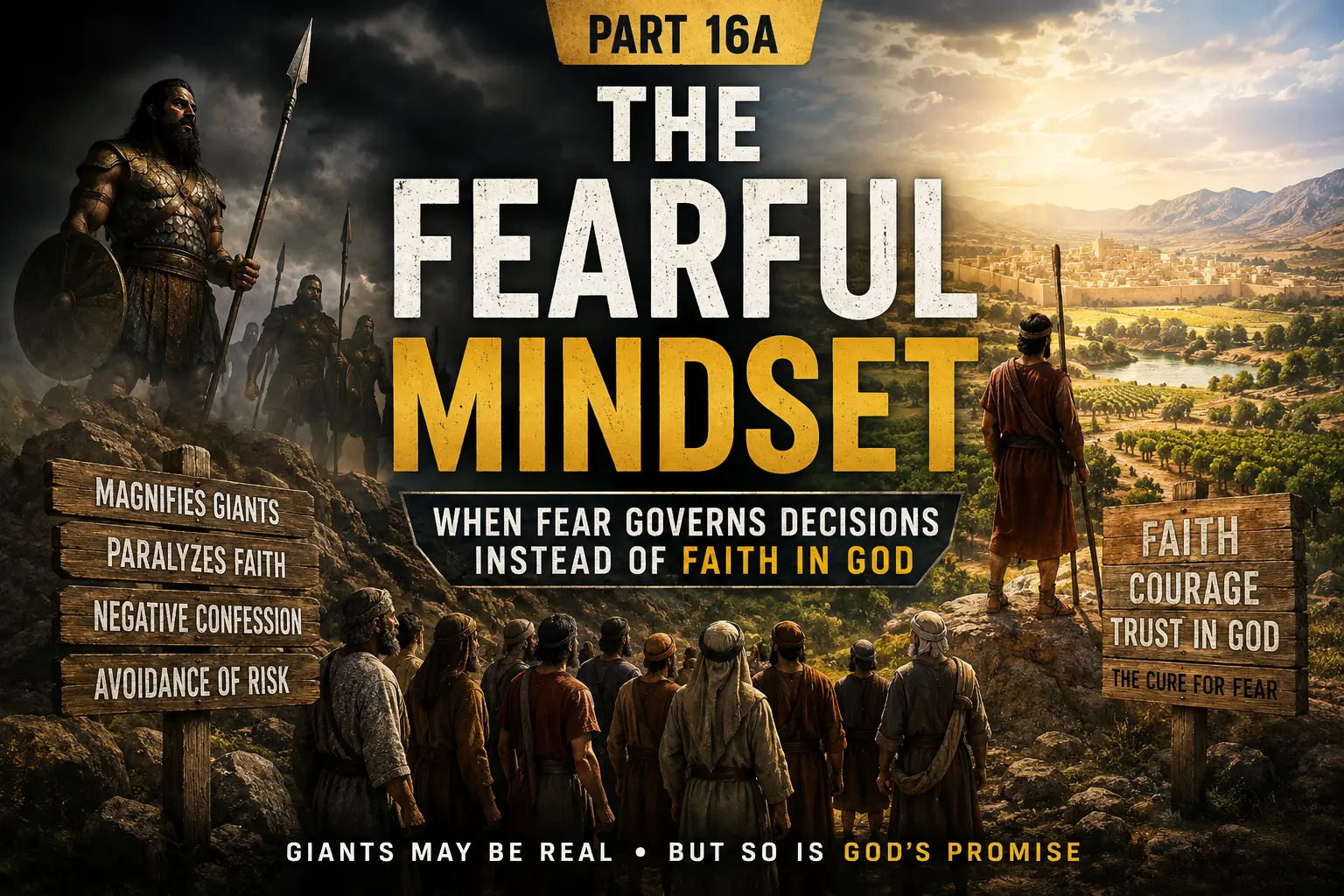
WHEN FEAR GOVERNS DECISIONS INSTEAD OF FAITH IN GOD
INTRODUCTION
Fear is one of the most powerful weapons used against the purpose of God in a person’s life. It does not always appear as open rebellion. Sometimes fear hides behind caution, delay, excuses, negative thinking, and “being realistic.” Yet when fear becomes the governing force of the mind, it begins to compete with faith. It shapes decisions, distorts perception, weakens obedience, and causes people to withdraw from the very promises God has placed before them.
The fearful mindset is not simply the feeling of fear. Every believer may experience moments of fear, pressure, uncertainty, or intimidation. The problem begins when fear becomes a mindset—a settled way of thinking that interprets life through danger, impossibility, failure, rejection, and defeat rather than through the faithfulness of God.
A fearful mindset magnifies giants and minimizes God. It exaggerates threats and forgets promises. It turns opportunities into dangers and assignments into impossibilities. It causes people to see themselves as victims of circumstance rather than sons and daughters of God who are called to walk by faith.
2 Timothy 1:7 NKJV
“For God has not given us a spirit of fear, but of power and of love and of a sound mind.”
This scripture makes it clear that fear is not the portion God gives His people. God does not govern His children through intimidation, panic, torment, or insecurity. He gives power, love, and a sound mind. Therefore, the fearful mindset must be confronted, renewed, and replaced with faith, courage, and trust in God.
DEFINITION OF THE FEARFUL MINDSET
The fearful mindset is a pattern of thinking controlled by intimidation, unbelief, insecurity, and the expectation of defeat. It causes a person to make decisions based on what could go wrong instead of what God has said.
It is a mindset that says the following:
- “I cannot.”
- “It is too dangerous.”
- “They are stronger than us.”
- “This will never work.”
- “We are not able.”
- “What if we fail?”
- “What if we lose?”
- “What if people reject us?”
Fear does not merely affect emotions. It affects vision, speech, obedience, relationships, and destiny. When fear dominates the mind, it becomes difficult to hear God accurately, obey promptly, and move forward boldly.
BIBLICAL EXAMPLE 1: THE TEN SPIES
One of the clearest biblical examples of the fearful mindset is found in Numbers 13–14. God had delivered Israel from Egypt, brought them through the Red Sea, fed them with manna, led them by the cloud and fire, and brought them to the border of the Promised Land. The promise was real. The land was prepared. God had already spoken.
Moses sent twelve spies to search out the land of Canaan. All twelve saw the same land, the same fruit, the same cities, and the same giants. Yet they did not all interpret what they saw the same way.
Caleb responded with faith.
Numbers 13:30 NKJV
“Then Caleb quieted the people before Moses, and said, ‘Let us go up at once and take possession, for we are well able to overcome it.’”
Caleb did not deny the existence of the giants. He did not pretend there were no fortified cities. His confidence was not based on the absence of difficulty, but on the presence and promise of God.
However, the ten spies responded with fear.
Numbers 13:31 NKJV
“But the men who had gone up with him said, ‘We are not able to go up against the people, for they are stronger than we.’”
This is the voice of a fearful mindset. It does not begin with God. It begins with the size of the enemy. It measures the promise by the problem instead of measuring the problem by the promise of God.
The fearful spies continued:
Numbers 13:32–33 NKJV
“And they gave the children of Israel a bad report of the land which they had spied out, saying, ‘The land through which we have gone as spies is a land that devours its inhabitants, and all the people whom we saw in
The Ten Spies—Fear Distorted their Reality
One of the clearest examples of the fearful mindset is found in the account of the twelve spies sent by Moses to inspect the land of Canaan. God had already promised the land to Israel. Canaan was not merely a possibility; it was an inheritance promised by God.
The spies were sent to view the land, not to decide whether God was able to give it to them. Their assignment was observation, not unbelief. However, ten of the twelve spies allowed fear to interpret what they saw.
They saw the same land Caleb and Joshua saw. They saw the same fruit, the same cities, and the same inhabitants. The difference was not in what they saw, but in how they interpreted what they saw.
Numbers 13:27 NKJV says:
“Then they told him, and said: ‘We went to the land where you sent us. It truly flows with milk and honey, and this is its fruit.’”
The spies confirmed that the land was good. The promise was real. The fruit was visible. God had not lied. Yet fear immediately added a contradiction.
Numbers 13:28 NKJV continues:
“Nevertheless, the people who dwell in the land are strong; the cities are fortified and very large; moreover we saw the descendants of Anak there.”
The word “nevertheless” reveals the entrance of fear. They acknowledged the goodness of the promise, but then allowed the size of the opposition to overshadow the faithfulness of God.
Caleb carried a different spirit. He did not deny the existence of giants, but he refused to give the giants authority over the promise.
Numbers 13:30 NKJV says:
“Then Caleb quieted the people before Moses, and said, ‘Let us go up at once and take possession, for we are well able to overcome it.’”
Caleb’s faith was not based on self-confidence. It was based on confidence in the God who had promised the land. Faith does not pretend there are no giants. Faith declares that giants are not greater than God.
CHARACTERISTICS OF THE FEARFUL MINDSET
A fearful mindset is not simply the presence of fear; it is the rule of fear. It is when fear becomes the lens through which a person interprets people, opportunities, problems, assignments, and the promises of God. In Numbers 13–14, the ten spies were not merely afraid for a moment; their fear became their conclusion, their confession, and their counsel to the nation. Fear governed their interpretation of reality.
The fearful mindset is revealed through the following characteristics:
-
Intimidation
Intimidation is one of the clearest characteristics of a fearful mindset. It occurs when a person becomes overwhelmed by the size, strength, voice, influence, or appearance of opposition. Intimidation does not necessarily mean the danger is not real; it means the danger has become greater in the mind than God’s promise, God’s presence, and God’s power.
A fearful mindset becomes intimidated when it allows what it sees to become louder than what God has said. This was the failure of the ten spies in Numbers 13. They entered the land God had promised to Israel, saw the fruitfulness of the land, confirmed that it was indeed good, but then allowed the giants to dominate their interpretation.
Numbers 13:27–28 NKJV
“Then they told him, and said: ‘We went to the land where you sent us. It truly flows with milk and honey, and this is its fruit. Nevertheless the people who dwell in the land are strong; the cities are fortified and very large; moreover we saw the descendants of Anak there.’”
The word “nevertheless” reveals the doorway through which fear entered. They acknowledged the goodness of the land, but they allowed the obstacles to overrule the promise. Their report began with fruitfulness, but it ended with fear. This is how intimidation works. It does not always deny that God is good; it simply magnifies the problem until the promise feels unreachable.
God had not hidden the land from them. He had not lied about the inheritance. The land was exactly what He said it would be. Yet the fearful spies allowed the presence of giants to cancel the confidence they should have had in God.
Intimidation Magnifies the Enemy
The intimidated mind gives excessive weight to the enemy. It studies the opposition more than it remembers the Lord. It rehearses the size of the obstacle, the strength of the adversary, the difficulty of the assignment, and the possibility of defeat.
Numbers 13:31 NKJV
“But the men who had gone up with him said, ‘We are not able to go up against the people, for they are stronger than we.’”
This statement shows that intimidation had taken control of their thinking. They did not say, “God is stronger than they are.” They said, “They are stronger than we are.” Their reasoning was based only on comparison between themselves and the enemy. They left God out of the equation.
That is the essence of intimidation: it measures the battle without considering the Lord.
A person under intimidation may say:
“We are not able.”
“This is too big for me.”
“They are too powerful.”
“I cannot face this.”
“I will lose.”
“I am too weak.”
“This will destroy me.”
These words may sound realistic, but when they exclude God, they become unbelief. Faith does not deny the existence of opposition; faith refuses to allow opposition to have the final word.
Intimidation Distorts Self-Image
Fearful intimidation does not only magnify the enemy; it also diminishes identity. The ten spies did not merely say the giants were big. They began to see themselves as small, powerless, and insignificant.
Numbers 13:33 NKJV
(33) There we saw the giants (the descendants of Anak came from the giants); and we were like grasshoppers in our own sight, and so we were in their sight.”
Paralysis is another major characteristic of a fearful mindset. Fear does not only affect what a person feels; it affects what a person does. When fear governs the mind, it can stop movement, delay obedience, and cause a person to remain stuck even when God has already given clear instruction.
Paralysis happens when fear overwhelms faith to the point where a person loses the courage to act. The fearful person may still hear the promise of God, but they struggle to move toward it. They may know what is right, but they hesitate to obey. They may recognize the opportunity, but they remain frozen because they are controlled by the possibility of failure, loss, rejection, or opposition.
This was clearly seen in Israel at the border of the Promised Land. God had already promised them Canaan, but when they heard the report of the ten spies, fear gripped the entire congregation. Instead of rising in faith, they cried, complained, and refused to move forward.
Numbers 14:1–2 NKJV
(1) So all the congregation lifted up their voices and cried, and the people wept that night.
(2) And all the children of Israel complained against Moses and Aaron, and the whole congregation said to them, “If only we had died in the land of Egypt! Or if only we had died in this wilderness!
Their fear produced emotional collapse. They were not thinking from promise; they were thinking from panic. Instead of preparing to possess the land, they spent the night weeping. Fear shifted them from faith-filled expectation to despair.
Paralysis often begins when the mind becomes overloaded with imagined outcomes. A fearful person starts thinking, “What if we fail? What if we are defeated? What if it costs too much? What if the enemy is too strong? What if God does not come through?” These thoughts become mental chains. The person is no longer moving by obedience but is being held hostage by possibility.
The problem with paralysis is that it can disguise itself as wisdom. A person may say, “I am just waiting,” when in reality they are afraid to obey. They may say, “I am being careful,” when they are actually avoiding responsibility. They may say, “The timing is not right,” when the real issue is unbelief. There is a difference between Spirit-led waiting and fear-driven delay. Spirit-led waiting strengthens obedience; fear-driven delay postpones obedience.
Israel did not merely hesitate; they refused to go forward.
Deuteronomy 1:26 NKJV
(26) “Nevertheless you would not go up, but rebelled against the command of the LORD your God;
This verse shows that fear-based paralysis can become rebellion. When God says move and fear says stay, the person must choose which voice will govern them. Israel’s refusal to move forward was not treated by God as caution; it was treated as disobedience. They were not waiting for more confirmation. God had already spoken. Their paralysis was rooted in unbelief.
Paralysis also makes people long for the familiar, even when the familiar was bondage. The Israelites began to desire Egypt again because Egypt felt predictable. Canaan had promise, but it also had warfare. Egypt had slavery, but it felt familiar. A fearful mindset will often choose familiar bondage over faith-filled movement.
Numbers 13:3-4 NKJV
(3) So Moses sent them from the Wilderness of Paran according to the command of the LORD, all of them men who were heads of the children of Israel.
(4) Now these were their names: from the tribe of Reuben, Shammua the son of Zaccur;
This is the danger of fear. It does not only stop progress; it can create backward movement. Fear can make a person desire what God already delivered them from. Instead of stepping into inheritance, Israel wanted to return to captivity.
A fearful mindset says, “At least I know what Egypt feels like.” Faith says, “God did not bring me out to abandon me; He brought me out to bring me in.”
Paralysis is also seen in the army of Israel during the days of David. When Goliath challenged Israel, the army stood frozen in fear. They were trained soldiers, but fear made them inactive.
1 Samuel 17:11 NKJV
(11) When Saul and all Israel heard these words of the Philistine, they were dismayed and greatly afraid.
Goliath’s voice intimidated them so deeply that no one moved forward. They had weapons, rank, numbers, and history with God, yet fear silenced their courage. This is what paralysis does. It makes capable people inactive. It makes called people hesitant. It makes equipped people withdraw.
David, however, revealed the opposite spirit. He did not deny the threat, but he refused to be governed by it. His confidence was in the Lord.
1 Samuel 17:45 NKJV
(45) Then David said to the Philistine, “You come to me with a sword, with a spear, and with a javelin. But I come to you in the name of the LORD of hosts, the God of the armies of Israel, whom you have defied.
David teaches us that fear is broken when God becomes bigger in our view than the thing confronting us. Paralysis loses its grip when faith begins to speak, move, and obey.
In modern life, paralysis may look like postponed decisions, delayed obedience, avoiding difficult conversations, refusing new assignments, staying in unhealthy environments, or never stepping into what God has called a person to do. A person may say they are waiting for perfect conditions, but faith often requires movement before everything looks safe.
Ecclesiastes 11:4 NKJV
(4) He who observes the wind will not sow, And he who regards the clouds will not reap.
This scripture warns against waiting for perfect conditions. If a person constantly watches the wind and clouds, they will never sow and never reap. Fearful people often wait until there is no risk, no opposition, no uncertainty, and no challenge. But faith does not require the absence of risk; faith requires confidence in the God who leads.
Paralysis keeps people at the edge of promise but prevents them from entering. It allows people to see what God has prepared, but not possess it. It creates a life of almost, someday, later, and what if. Many people do not miss purpose because they were incapable; they miss purpose because fear froze their obedience.
The cure for paralysis is faith-filled obedience. God does not always remove every giant before He commands us to move. Sometimes He commands us to move so that we may discover His power in the movement.
Joshua 1:9 NKJV
(9) Have I not commanded you? Be strong and of good courage; do not be afraid, nor be dismayed, for the LORD your God is with you wherever you go.”
God’s answer to paralysis is not passivity; it is courage. He calls His people to rise, move, obey, and trust Him. The believer must not allow fear to hold them in a place God has called them to leave, nor prevent them from entering a place God has promised them to possess.
Paralysis is broken when obedience becomes greater than fear.
-
Negative Confession
Negative confession is another major characteristic of a fearful mindset. It is the language of fear. When fear fills the heart, it often comes out through the mouth in the form of defeat, unbelief, complaint, accusation, exaggeration, and hopelessness.
Negative confession is one of the most destructive expressions of a fearful mindset. Fear does not remain silent for long. Whatever dominates the heart will eventually come out of the mouth. When fear governs the mind, it begins to shape language, and that language becomes a confession of defeat, impossibility, complaint, and unbelief.
A negative confession is not merely “speaking honestly” about a situation. It is when a person’s words agree more with fear than with the promise of God. It is when the mouth begins to proclaim what fear sees instead of what faith believes.
Jesus taught that the mouth reveals the condition of the heart.
Luke 6:45 NKJV
“A good man out of the good treasure of his heart brings forth good; and an evil man out of the evil treasure of his heart brings forth evil. For out of the abundance of the heart his mouth speaks.”
A fearful mindset does not only think negatively; it speaks negatively. It gives voice to fear until fear becomes the atmosphere around the person. What begins as a thought becomes a confession. What becomes a confession can influence decisions, discourage others, and create agreement with unbelief.
Jesus taught that words reveal the condition of the heart.
Matthew 12:34 NKJV
“Brood of vipers! How can you, being evil, speak good things? For out of the abundance of the heart the mouth speaks.”
This means that negative confession is not merely a speech problem; it is a heart and mindset problem. When fear rules the inner man, the mouth begins to release the language of fear.
The fearful mindset says:
“We are not able.”
“This will never work.”
“We are going to fail.”
“The enemy is too strong.”
“God has abandoned us.”
“It would have been better to stay where we were.”
“We will die here.”
“There is no way forward.”
These statements may sound like honest realism, but when they contradict the promise, presence, and power of God, they become unbelief spoken aloud.
Negative Confession Was Seen in the Ten Spies
The ten spies revealed their fearful hearts through their words. Their report was not just information; it became a confession. Their language shaped the atmosphere of the entire nation.
The ten spies did not simply feel afraid; they spoke fear over the whole congregation. Their words were not neutral. Their words carried the spirit of intimidation, defeat, and unbelief.
Numbers 13:31 NKJV
(31) But the men who had gone up with him said, “We are not able to go up against the people, for they are stronger than we.”
The phrase “We are not able” is the language of a fearful mindset. It is a confession that places human weakness above divine promise. God had already promised the land, but their speech denied their ability to possess what God had already given.
Negative confession does not always sound rebellious at first. Sometimes it sounds practical, cautious, or realistic. However, when a confession contradicts what God has spoken, it becomes unbelief dressed in the language of realism.
They did not say, “The giants are great, but our God is greater.”
They did not say, “The cities are fortified, but the Lord who opened the Red Sea is with us.”
They did not say, “The battle is real, but the promise is sure.”
Instead, they said, “We are not able.”
This is how negative confession works. It interprets the future without faith. It speaks as though God is absent. It makes human weakness the final authority and forgets divine strength.
Caleb carried a different spirit. He saw the same giants, the same cities, and the same land, but he spoke from faith.
Numbers 13:30 NKJV
“Then Caleb quieted the people before Moses, and said, ‘Let us go up at once and take possession, for we are well able to overcome it.’”
Caleb’s confession was not based on self-confidence alone; it was rooted in confidence in God. He did not deny the battle, but he refused to speak defeat over what God had promised.
Fear says, “We are not able.”
Faith says, “We are well able because God is with us.”
Negative Confession Distorts Reality
The ten spies continued speaking until their report became exaggerated and distorted. Fear does not simply describe reality; it often enlarges the problem beyond truth.
Numbers 13:32-33 NKJV
(32) And they gave the children of Israel a bad report of the land which they had spied out, saying, “The land through which we have gone as spies is a land that devours its inhabitants, and all the people whom we saw in it are men of great stature.
(33) There we saw the giants (the descendants of Anak came from the giants); and we were like grasshoppers in our own sight, and so we were in their sight.”
Negative Confession Spreads Fear to Others
The ten spies did not keep their fear private. Their words affected the whole congregation. Fearful speech has the power to infect the atmosphere around it. One fearful voice can weaken many hearts if it is allowed to dominate the conversation.
Negative Confession Magnifies the Problem
The fearful mindset often uses words that enlarge the problem beyond its proper measure. The ten spies did not only report that the land had strong people and fortified cities. They exaggerated the danger until the land itself sounded impossible to possess.
Numbers 13:32 NKJV
(32) And they gave the children of Israel a bad report of the land which they had spied out, saying, “The land through which we have gone as spies is a land that devours its inhabitants, and all the people whom we saw in it are men of great stature.
-
Avoidance of Risk
Avoidance of risk is another powerful characteristic of the fearful mindset. Fear does not only intimidate the heart, paralyze movement, and produce negative confession; it also teaches people to avoid anything that requires faith. A fearful mindset looks for safety before obedience, certainty before movement, and comfort before sacrifice.
Risk, in this context, does not mean recklessness or foolishness. Biblical faith is never careless, irresponsible, or presumptuous. However, there are moments when obedience to God requires a person to step beyond comfort, familiarity, personal control, and visible security. Faith often requires movement before every detail is understood.
Hebrews 11:8 NKJV
(8) By faith Abraham obeyed when he was called to go out to the place which he would receive as an inheritance. And he went out, not knowing where he was going.
Abraham’s obedience involved risk. He left what was known for what God had promised. He did not have every answer, every map, or every visible guarantee. His confidence was not in perfect circumstances; his confidence was in the God who called him.
A fearful mindset struggles with this kind of obedience because it wants complete assurance before taking a step. It says, “I will obey when I know how everything will work out.” Faith says, “I will obey because God has spoken.”
The Ten Spies Avoided the Risk of Possessing the Promise
The ten spies saw Canaan, but they were unwilling to embrace the risk required to possess it. The land was fruitful, but it was not without warfare. The promise was real, but the process demanded faith, courage, and obedience.
Numbers 13:27-28 NKJV
(27) Then they told him, and said: “We went to the land where you sent us. It truly flows with milk and honey, and this is its fruit.
(28) Nevertheless the people who dwell in the land are strong; the cities are fortified and very large; moreover we saw the descendants of Anak there.
They acknowledged the fruit, but they focused on the fight. They saw the evidence of God’s promise, but they became consumed by the cost of possessing it. The word “nevertheless” revealed their fear. They were willing to admire the land, discuss the land, and report on the land, but they were not willing to enter the land by faith.
This is one of the tragedies of a fearful mindset: it can stand close enough to see the promise, but remain too afraid to possess it.
Many people do the same spiritually. They see what God is calling them into, but they avoid the responsibility, warfare, confrontation, sacrifice, discipline, or uncertainty attached to it. They want inheritance without battle, fruit without obedience, and breakthrough without risk.
Avoidance of Risk Chooses Familiar Bondage Over Faith-Filled Movement
When fear controls the mind, the unknown becomes more frightening than bondage. Israel had been delivered from Egypt, yet when they faced the risk of entering Canaan, they wanted to return to the place God had already brought them out of.
Numbers 14:3-4 NKJV
(3) Why has the LORD brought us to this land to fall by the sword, that our wives and children should become victims? Would it not be better for us to return to Egypt?”
(4) So they said to one another, “Let us select a leader and return to Egypt.”
This reveals the depth of fear. Egypt represented slavery, oppression, hard labor, and bondage. Yet because Egypt was familiar, they preferred it to the uncertainty of warfare in Canaan. Fear made bondage look safer than promise.
The fearful mindset often reasons this way:
- “It may not be God’s best, but at least I know it.”
- “It may be bondage, but at least it feels familiar.”
- “It may be limiting me, but at least I feel safe.”
- “It may not be my inheritance, but at least I do not have to fight.”
This kind of thinking keeps people trapped in old places, old cycles, old relationships, old systems, and old limitations. They do not remain there because God has not spoken. They remain there because fear has convinced them that movement is too costly.
Avoidance of Risk Delays Obedience
Fearful people often postpone obedience by waiting for conditions that require no faith. They say, “When the situation is easier, I will move.” “When there is no opposition, I will obey.” “When I feel ready, I will step out.” But many divine assignments will never feel safe to the flesh.
Ecclesiastes 11:4 NKJV
(4) He who observes the wind will not sow, And he who regards the clouds will not reap.
This scripture exposes the danger of waiting for perfect conditions. If a person keeps watching the wind, they will never sow. If they keep studying the clouds, they will never reap. Fear can make a person overanalyse every possibility until obedience is continually postponed.
There is wisdom in planning, but there is bondage in endless hesitation. There is prudence in counting the cost, but there is unbelief in refusing to obey after God has spoken. The fearful mindset hides behind delay because delay feels safer than decision.
Avoidance of risk often sounds like:
- “I am still praying,” when God has already answered.
- “I am waiting for confirmation,” when God has already confirmed.
- “I need more time,” when fear is actually resisting obedience.
- “I am being careful,” when the real issue is fear of failure.
There is a difference between Spirit-led timing and fear-driven delay. Spirit-led timing produces peace, preparation, and obedience. Fear-driven delay produces excuses, stagnation, and missed opportunity.
Avoidance of Risk Buries What God Gave
Jesus also addressed the danger of fear-driven avoidance in the parable of the talents. One servant received one talent, but because he was afraid, he refused to take any risk with what his master had entrusted to him.
Matthew 25:24-25 NKJV
(24) “Then he who had received the one talent came and said, ‘Lord, I knew you to be a hard man, reaping where you have not sown, and gathering where you have not scattered seed.
(25) And I was afraid, and went and hid your talent in the ground. Look, there you have what is yours.’
The servant openly confessed the root of his inactivity: “I was afraid.” His fear caused him to bury what he was supposed to multiply. He protected the talent from loss, but he also prevented it from increase.
This is what fear does. It convinces people that burying is safer than investing, hiding is safer than serving, and doing nothing is safer than obeying. But in the Kingdom, buried potential is not faithfulness. God does not entrust grace, gifts, opportunities, and assignments to His people so they can hide them in fear. He expects stewardship, movement, obedience, and multiplication.
The fearful servant thought safety would please the master, but his master rebuked him.
Matthew 25:26 NKJV
(26) “But his lord answered and said to him, ‘You wicked and lazy servant, you knew that I reap where I have not sown, and gather where I have not scattered seed.
This is sobering. The master did not call the servant careful; he called him wicked and lazy. Fear had produced inactivity, and inactivity became unfaithfulness. The fearful mindset can make a person appear cautious on the outside while they are disobedient on the inside.
Avoidance of Risk Produces Missed Inheritance
Israel’s refusal to enter Canaan had serious consequences. Because they avoided the risk of faith, they forfeited the inheritance prepared for that generation.
Numbers 14:22-23 NKJV
(22) because all these men who have seen My glory and the signs which I did in Egypt and in the wilderness, and have put Me to the test now these ten times, and have not heeded My voice,
(23) they certainly shall not see the land of which I swore to their fathers, nor shall any of those who rejected Me see it.
Fear does not merely delay progress; it can cause people to miss seasons of inheritance. The issue was not that God lacked power. The issue was that Israel refused to trust Him. Their avoidance of risk became rejection of God’s voice.
A fearful mindset can keep people circling in the wilderness while calling it survival. They may remain alive, but they are not advancing. They may continue existing, but they are not possessing. They may avoid danger, but they also avoid destiny.
Faith Requires Courage to Step Into the Unknown
The cure for avoidance of risk is not recklessness; it is obedient faith. Faith does not mean a person has no questions, no pressure, and no awareness of danger. Faith means the Word of God becomes greater than the fear of uncertainty.
Joshua and Caleb carried a different spirit. They understood the danger, but they also understood the power and presence of God.
Numbers 14:8-9 NKJV
(8) If the LORD delights in us, then He will bring us into this land and give it to us, ‘a land which flows with milk and honey.’
(9) Only do not rebel against the LORD, nor fear the people of the land, for they are our bread; their protection has departed from them, and the LORD is with us. Do not fear them.”
Joshua and Caleb did not call Israel to reckless ambition. They called Israel to trust the Lord. Their confidence was rooted in one statement:
“The LORD is with us.” That is what breaks the avoidance of risk. When a believer becomes convinced that God is with them, they can obey even when the assignment contains uncertainty.
Faith says:
- “God is with me.”
- “God has spoken.”
- “God is faithful.”
- “God will strengthen me.”
- “God will make a way.”
- “God is greater than the giants.”
Conclusion: Fear Avoids Risk, but Faith Possesses Promise
Avoidance of risk keeps people near the promise but outside of possession. It makes them admire what God has prepared while refusing the obedience required to enter it. It protects comfort but sacrifices inheritance. It avoids warfare but loses territory.
The fearful mindset asks, “What if we fail?” Faith asks, “What has God said?”
The fearful mindset says, “It is safer to stay where I am.” Faith says, “It is safer to obey God than to remain in disobedience.”
The fearful mindset avoids risk because it trusts visible security more than divine promise. But the renewed mind understands that the safest place is not always the easiest place; the safest place is the will of God.
Psalms 56:3-4 NKJV
(3) Whenever I am afraid, I will trust in You.
(4) In God (I will praise His word), In God I have put my trust; I will not fear. What can flesh do to me?
Avoidance of risk is broken when trust in God becomes stronger than the fear of failure. The believer must not allow fear to bury gifts, delay obedience, or forfeit inheritance. God calls His people to walk by faith, move with courage, and trust Him beyond the borders of comfort.
Fear avoids the risk of obedience, but faith steps forward and possesses what God has promised.
OTHER PUBLICATIONS BY THIS AUTHOR CAN BE FOUND AT: