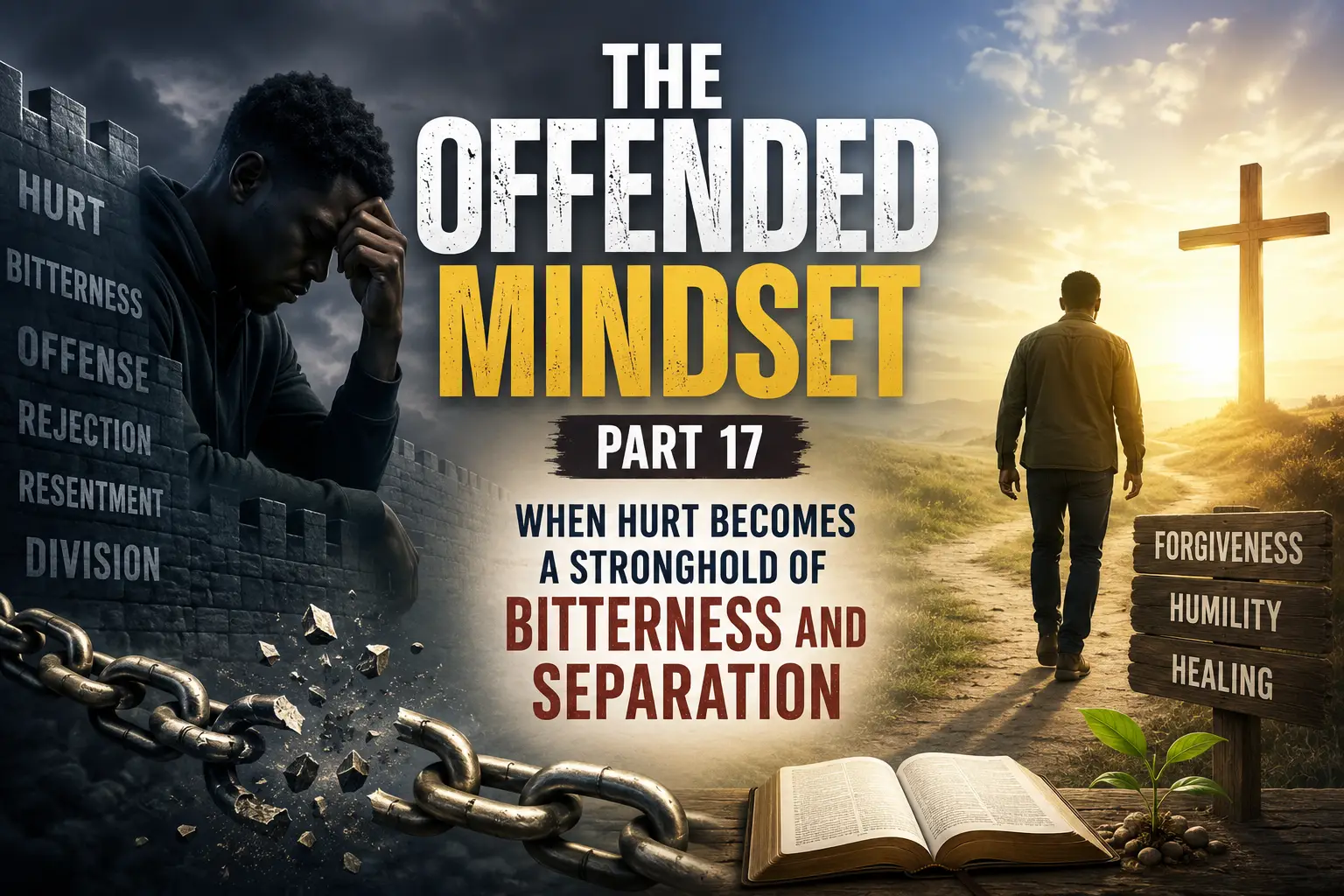
THE OFFENDED MINDSET PART—WHEN HURT BECOMES A STRONGHOLD OF BITTERNESS AND SEPARATION
INTRODUCTION
The offended mindset is one of the most subtle, yet destructive weapons used against the heart of a believer. Many people do not backslide because they stopped believing in God; they withdraw because they were hurt, disappointed, misunderstood, corrected, overlooked, betrayed, or dishonoured. When that hurt is not processed in the presence of God, it can harden into offense. When offense is not dealt with, it can grow into bitterness. When bitterness matures, it often produces separation, accusation, division, and spiritual paralysis.
The danger of offense is that it often begins with a legitimate wound. Someone may truly have spoken wrongly, acted unfairly, ignored you, betrayed your trust, or failed to honour you properly. However, the issue is not only what happened to us, but what we allow to happen inside us after it happened. Hurt becomes dangerous when it begins to govern our thoughts, shape our reactions, distort our perception, and separate us from God-given relationships.
The offended mindset is therefore not simply a moment of pain. It is a pattern of thinking where hurt becomes a stronghold. It causes a person to interpret life through rejection, suspicion, anger, and self-protection. Instead of allowing God to heal the wound, the offended heart begins to build walls around the wound.
Proverbs 18:19 NKJV
(19) A brother offended is harder to win than a strong city, And contentions are like the bars of a castle.
This verse reveals the fortified nature of offense. An offended person can become difficult to reach because offense builds internal walls. The person may still attend church, quote Scripture, worship outwardly, and speak spiritual language, but inwardly they are guarded, withdrawn, defensive, and resistant to reconciliation.
The offended mindset is dangerous because it does not only damage the person who carries it; it damages families, churches, friendships, ministries, and assignments. Offense separates what God joined together, delays healing, and gives the enemy legal ground to sow bitterness and division.
DEFINITION OF AN OFFENDED MINDSET
An offended mindset is a pattern of thinking and responding where unresolved hurt becomes a stronghold of bitterness, defensiveness, resentment, and separation.
It is the condition of a heart that has allowed pain to become a lens. Through this lens, correction is interpreted as rejection, delay is interpreted as dishonour, silence is interpreted as neglect, and disagreement is interpreted as betrayal.
An offended person does not merely remember what happened; they keep reliving it. The event may be over, but the wound keeps speaking. The pain becomes a voice. The voice becomes a narrative. The narrative becomes a belief system. Eventually, the person begins to see themselves as a victim and others as enemies.
The offended mindset says:
- “I will never trust again.”
- “They do not value me.”
- “I was right to withdraw.”
- “They must come to me first.”
- “I will protect myself from being hurt again.”
- “I will not forgive until they suffer like I suffered.”
These thoughts may feel justified, but they are spiritually dangerous. They keep the heart imprisoned to the past and prevent the grace of God from producing healing and maturity.
2 Corinthians 10:4–5 NKJV teaches that strongholds must be pulled down and every thought brought into obedience to Christ. Offense is one of those internal strongholds that must be confronted, not excused.
2 Corinthians 10:4-5 NKJV
(4) For the weapons of our warfare are not carnal but mighty in God for pulling down strongholds,
(5) casting down arguments and every high thing that exalts itself against the knowledge of God, bringing every thought into captivity to the obedience of Christ,
Biblical Example: Cain — When Offense Led to Murder
The first major biblical picture of an offended mindset is Cain. Cain’s offense did not begin with Abel attacking him. It began when God accepted Abel’s offering and did not respect Cain’s offering.
Genesis 4:3-5 NKJV
(3) And in the process of time it came to pass that Cain brought an offering of the fruit of the ground to the LORD.
(4) Abel also brought of the firstborn of his flock and of their fat. And the LORD respected Abel and his offering,
(5) but He did not respect Cain and his offering. And Cain was very angry, and his countenance fell.
This scripture records that Cain brought an offering to the Lord, and Abel also brought of the firstborn of his flock. The Lord respected Abel and his offering, but He did not respect Cain and his offering. The result was that “Cain was very angry, and his countenance fell.”
Cain’s problem was not simply disappointment. His response revealed the condition of his heart. Instead of allowing God’s correction to bring repentance, he allowed comparison to produce offense.
God confronted Cain before the offense became destructive.
Genesis 4:6-7 NKJV
(6) So the LORD said to Cain, “Why are you angry? And why has your countenance fallen?
(7) If you do well, will you not be accepted? And if you do not do well, sin lies at the door. And its desire is for you, but you should rule over it.”
God gave Cain an opportunity to rule over the inward condition before it ruled over him. The Lord warned him that sin was lying at the door and desired to master him. This is a powerful picture of offense. Offense often stands at the door of the heart, waiting for permission to enter, dominate, and direct behaviour.
Cain refused correction. He refused repentance. He refused humility. Instead of dealing with what was wrong inside himself, he turned against his brother.
Genesis 4:8 NKJV
(8) Now Cain talked with Abel his brother; and it came to pass, when they were in the field, that Cain rose up against Abel his brother and killed him.
Cain’s offense became murder. What began as anger over rejection became violence against the righteous. Cain did not kill Abel because Abel had harmed him. He killed Abel because Abel’s righteousness exposed his own heart.
1 John 3:12 NKJV explains the deeper issue:
1 John 3:12 NKJV
(12) not as Cain who was of the wicked one and murdered his brother. And why did he murder him? Because his works were evil and his brother’s righteous.
This is a sobering lesson. Offense often causes people to attack the person who exposes their condition. Instead of asking, “Lord, what must change in me?” the offended person asks, “Who can I blame?” Cain could have repented and been restored, but he chose resentment and separation.
Cain became a wanderer because he refused to be healed. Offense always creates distance. It separates a person from God, from people, from purpose, and from peace.
THE ROOT OF THE OFFENDED MINDSET
Offense is usually rooted in unmet expectations, wounded pride, rejection, jealousy, comparison, correction, betrayal, or misunderstanding. It begins when something touches a sensitive place in the heart.
Sometimes offense comes because someone genuinely sinned against us. Other times offense comes because our pride was confronted, our motives were exposed, our expectations were not met, or our desire for recognition was frustrated.
In Cain’s case, Abel did not attack him. Abel simply obeyed God. Cain became offended because another person’s obedience exposed his own deficiency. This shows that offense is not always caused by mistreatment. Sometimes it is caused by comparison.
James 3:16 NKJV
(16) For where envy and self-seeking exist, confusion and every evil thing are there.
Cain’s offense was connected to envy and self-seeking. He wanted acceptance without adjustment. He wanted honor without obedience. He wanted God’s approval without changing his heart.
This is still true today. Many people become offended when God blesses someone else, uses someone else, corrects them through someone else, or promotes someone else. Instead of celebrating grace, offense turns the heart inward and says, “What about me?”
CHARACTERISTICS OF AN OFFENDED MINDSET
-
Easily Hurt
The offended mindset is easily hurt because it carries unhealed wounds. When the heart is not healed, small matters can produce large reactions. A simple correction can feel like rejection. A delayed response can feel like dishonor. A misunderstanding can feel like betrayal.
This does not mean that every hurt is imaginary. Some wounds are real. However, the offended mindset magnifies hurt and allows it to define reality.
Ecclesiastes 7:9 NKJV
(9) Do not hasten in your spirit to be angry, For anger rests in the bosom of fools.
An offended person often becomes quick to anger because their inner life is already wounded. They respond not only to the present moment, but to accumulated pain from the past.
Cain was easily moved into anger because his heart was not submitted to God. His countenance fell before his hands became violent. This means the offense first showed on his face before it manifested in his actions. Many people reveal offense through silence, withdrawal, facial expressions, sharp responses, sarcasm, avoidance, and emotional distance long before they openly attack.
James 1:19–20 NKJV gives the cure for impulsive emotional reactions:
James 1:19-20 NKJV
(19) So then, my beloved brethren, let every man be swift to hear, slow to speak, slow to wrath;
(20) for the wrath of man does not produce the righteousness of God.
An easily hurt person must learn to pause before reacting. They must bring the wound before God before allowing the wound to speak through their mouth.
-
Defensive
The offended mindset is defensive because it protects pain instead of surrendering it to God. A defensive person struggles to receive correction, instruction, counsel, or confrontation. They hear attack even when someone is trying to help them.
Cain was defensive before God. When God asked him about Abel, Cain responded, “Am I my brother’s keeper?” His answer was not humble, repentant, or broken. It was evasive and defensive.
Genesis 4:9 NKJV
(9) Then the LORD said to Cain, “Where is Abel your brother?” He said, “I do not know. Am I my brother’s keeper?”
This defensive statement reveals a hardened heart. Cain did not take responsibility. He deflected. He minimized. He avoided accountability.
Defensiveness is dangerous because it keeps a person from repentance. As long as someone is defending their wound, they cannot be healed from it. As long as they are defending their reaction, they cannot be transformed.
Proverbs 12:1 NKJV
(1) Whoever loves instruction loves knowledge, But he who hates correction is stupid.
Correction is not rejection. God corrects those He loves. People who cannot receive correction often remain trapped in cycles of offense because they interpret every challenge as an attack on their worth.
Hebrews 12:11 NKJV reminds us that discipline is painful in the moment, but it produces “the peaceable fruit of righteousness” in those who are trained by it.
Hebrews 12:11 NKJV
(11) Now no chastening seems to be joyful for the present, but painful; nevertheless, afterward it yields the peaceable fruit of righteousness to those who have been trained by it.
The offended mindset rejects training because it wants comfort more than transformation.
-
Bitterness
Bitterness is offense that has been stored too long. It is hurt that has fermented. It is resentment that has taken root in the heart. Bitterness does not remain private; it eventually affects words, attitudes, relationships, and spiritual atmosphere.
Hebrews 12:15 NKJV warns:
Hebrews 12:15 NKJV
(15) looking carefully lest anyone fall short of the grace of God; lest any root of bitterness springing up cause trouble, and by this many become defiled;
Bitterness begins as a root before it becomes visible fruit. Roots are hidden. This means bitterness can live beneath the surface while a person still looks functional outwardly. They may still serve, preach, sing, give, or attend church, but internally they are carrying poison.
Bitterness causes people to replay offenses. It keeps records. It remembers tone, date, words, facial expressions, and details of pain. It rehearses arguments in the mind. It imagines confrontations. It builds a case against others.
Ephesians 4:31 NKJV
(31) Let all bitterness, wrath, anger, clamor, and evil speaking be put away from you, with all malice.
Bitterness must be put away. It will not leave automatically. It must be renounced, uprooted, confessed, and replaced with forgiveness.
Cain allowed bitterness to mature until he murdered Abel. Most people may never commit physical murder, but Jesus taught that hatred in the heart is already spiritually destructive. Bitterness murders love, trust, fellowship, unity, and honor.
1 John 3:15 NKJV
(15) Whoever hates his brother is a murderer, and you know that no murderer has eternal life abiding in him.
This does not mean every hurt person is a murderer in action, but it reveals the seriousness of hatred in the heart. Bitterness is not a small issue. It is a spiritual poison that must be removed before it destroys the vessel carrying it.
-
Division
The offended mindset produces division because offense seeks agreement. An offended person rarely wants to be offended alone. They often recruit others into their pain, telling the story in a way that justifies their position and turns others against the person who hurt them.
This is how division spreads. One person’s unresolved wound becomes a group’s shared suspicion. The offense becomes a narrative, and the narrative becomes a faction.
Matthew 24:10 NKJV
(10) And then many will be offended, will betray one another, and will hate one another.
This verse shows the progression of offense: offense leads to betrayal, and betrayal leads to hatred. Offense is therefore not harmless. If left unchecked, it moves people from hurt into hostility.
Division is one of the most visible fruits of offense. It separates husbands and wives, parents and children, spiritual fathers and sons, leaders and followers, friends and congregations. It causes people to leave relationships without healing, avoid difficult conversations, and justify separation as wisdom when it may actually be wounded self-protection.
Romans 16:17 NKJV warns believers to note those who cause divisions and offenses contrary to sound doctrine.
Romans 16:17 NKJV
(17) Now I urge you, brethren, note those who cause divisions and offenses, contrary to the doctrine which you learned, and avoid them.
Division is not only a relational issue; it becomes a doctrinal and spiritual issue when it violates the nature of Christ’s body.
Cain separated himself from Abel through murder, but his deeper separation was already internal. He was separated from love, humility, brotherhood, accountability, and God’s correction before he was separated geographically.
Offense always moves toward isolation. Healing moves toward reconciliation where possible.
Other Biblical Pictures of Offense
Esau: Offense That Became Generational Hostility
Esau became bitter after Jacob received the blessing. Although Jacob’s actions were deceptive, Esau’s response became murderous.
Genesis 27:41 NKJV
(41) So Esau hated Jacob because of the blessing with which his father blessed him, and Esau said in his heart, “The days of mourning for my father are at hand; then I will kill my brother Jacob.”
Esau’s offense produced hatred. His pain was real, but his response became dangerous. This teaches us that even when someone has wronged us, we must still guard our hearts from hatred.
Absalom: Offense That Became Rebellion
Absalom carried unresolved offense after the violation of his sister Tamar. David failed to properly address the matter, and Absalom’s anger grew in silence. Eventually, his offense became rebellion against his father’s throne.
2 Samuel 13:22 NKJV says Absalom “spoke to his brother Amnon neither good nor bad,” because he hated him.
2 Samuel 13:22 NKJV
(22) And Absalom spoke to his brother Amnon neither good nor bad. For Absalom hated Amnon, because he had forced his sister Tamar.
Silent hatred eventually became destructive action.
Absalom teaches us that suppressed offense does not disappear. If it is not healed, it grows underground until it becomes rebellion, manipulation, and division.
The Older Brother: Offense at Grace Given to Another
In Luke 15, the older brother became offended when the father celebrated the return of the prodigal son. His offense was not caused by injustice against him, but by mercy shown to someone else.
Luke 15:28 NKJV
(28) “But he was angry and would not go in. Therefore his father came out and pleaded with him.
The older brother was in the house physically, but outside the father’s joy emotionally. This is a powerful picture of religious offense. A person can remain near the house of God but distant from the heart of the Father.
THE REDEMPTIVE CURE FOR THE OFFENDED MINDSET
The offended mindset can be healed, but it requires honesty before God. Offense does not leave because we ignore it. It leaves when we bring the wound into the light, choose forgiveness, humble ourselves, and allow the Holy Spirit to heal what pain has damaged.
-
Forgiveness
Forgiveness is the first major cure for offense. Forgiveness does not deny that pain happened. It does not excuse sin, erase accountability, or pretend that betrayal was acceptable. Forgiveness means we release the person from our personal revenge and place the matter into the hands of God.
Colossians 3:13 NKJV
(13) bearing with one another, and forgiving one another, if anyone has a complaint against another; even as Christ forgave you, so you also must do.
The standard of forgiveness is Christ. We forgive because we have been forgiven. We release because we have been released. We show mercy because mercy was shown to us.
Jesus also taught that forgiveness must be repeated when necessary.
Luke 17:3-4 NKJV
(3) Take heed to yourselves. If your brother sins against you, rebuke him; and if he repents, forgive him.
(4) And if he sins against you seven times in a day, and seven times in a day returns to you, saying, ‘I repent,’ you shall forgive him.”
Scripture teaches that if a brother sins and repents, we must forgive him, even repeatedly. This does not mean we ignore patterns of abuse or refuse wisdom. It means we do not allow repeated injury to make us prisoners of bitterness.
Forgiveness is not always a feeling at first. Sometimes it begins as an act of obedience. The emotions may follow later as healing deepens. The decision to forgive opens the door for God to cleanse the heart.
Matthew 6:4-5 NKJV
(4) that your charitable deed may be in secret; and your Father who sees in secret will Himself reward you openly.
(5) “And when you pray, you shall not be like the hypocrites. For they love to pray standing in the synagogues and on the corners of the streets, that they may be seen by men. Assuredly, I say to you, they have their reward.
Scripture further warns that if we forgive others, our heavenly Father will forgive us, but if we refuse to forgive, we place ourselves in spiritual danger. An unforgiving heart blocks the flow of grace.
Forgiveness breaks the legal grip of offense.
-
Humility
Humility is essential because offense often survives through pride. Pride says, “I was wronged, so I have the right to remain angry.” Humility says, “Lord, even though I was hurt, I do not want my heart to become corrupted.”
Cain lacked humility. God confronted him directly, but Cain refused to bow. If Cain had humbled himself, his story could have ended differently.
1 Peter 5:5 NKJV
(5) Likewise you younger people, submit yourselves to your elders. Yes, all of you be submissive to one another, and be clothed with humility, for “GOD RESISTS THE PROUD, BUT GIVES GRACE TO THE HUMBLE.”
Grace flows toward humility. The offended person needs grace, but grace is received through humility. Humility allows us to ask difficult questions:
- “Lord, what is happening in my heart?”
- “Am I seeing this situation correctly?”
- “Have I allowed bitterness to grow?”
- “Is my reaction righteous or wounded?”
- “Am I willing to forgive?”
- “Do I want healing or do I want revenge?”
Humility does not mean we pretend we were not hurt. It means we surrender our hurt to God instead of enthroning it in our hearts.
Philippians 2:5 NKJV
(5) Let this mind be in you which was also in Christ Jesus,
The mind of Christ is not proud, retaliatory, bitter, or self-protective. Jesus was rejected, betrayed, mocked, falsely accused, and crucified, yet He did not allow offense to govern Him.
1 Peter 2:23 NKJV says that when Jesus was reviled, He “did not revile in return,” but committed Himself to the One who judges righteously.
1 Peter 2:23 NKJV
(23) who, when He was reviled, did not revile in return; when He suffered, He did not threaten, but committed Himself to Him who judges righteously;
This is the humility that defeats offense.
-
Healing
Forgiveness releases the offender, but healing restores the wounded heart. Many people try to forgive without allowing God to heal the wound. As a result, they may say the right words but remain internally guarded, suspicious, and fragile.
Psalms 147:3 NKJV
(3) He heals the brokenhearted And binds up their wounds.
God does not only command forgiveness; He provides healing. The Lord is not indifferent to pain. He sees betrayal, rejection, dishonour, abandonment, abuse, and disappointment. He does not minimize wounds. He heals them.
Healing requires bringing the truth of the wound into the presence of God. It may involve prayer, confession, godly counsel, honest conversation, repentance, accountability, and time. Some wounds are deep, and healing may be a process.
However, the process begins when we stop protecting the offense and start surrendering the pain.
Isaiah 61:1 NKJV speaks of the anointing to “heal the brokenhearted.”
Isaiah 61:1 NKJV
(1) “The Spirit of the Lord GOD is upon Me, Because the LORD has anointed Me To preach good tidings to the poor; He has sent Me to heal the brokenhearted, To proclaim liberty to the captives, And the opening of the prison to those who are bound;
This is part of the ministry of Christ. Jesus does not only save souls; He restores hearts.
Healing also requires renewing the mind. The offended person must stop rehearsing the offense and start meditating on truth.
Romans 12:2 NKJV
(2) And do not be conformed to this world, but be transformed by the renewing of your mind, that you may prove what is that good and acceptable and perfect will of God.
Romans 12:2 NKJV teaches that transformation comes through the renewing of the mind. If the mind keeps replaying the wound, the heart remains trapped. If the mind is renewed by truth, the heart becomes free.
PRACTICAL STEPS TO OVERCOME THE OFFENDED MINDSET
-
Acknowledge the Offense Honestly
Do not deny the wound. Bring it before God. Pray honestly and say, “Lord, I am hurt. I feel rejected. I feel angry. I feel betrayed. But I do not want this pain to become a stronghold.”
Healing begins with truth.
-
Refuse to Meditate on the Offense
Stop replaying the event in your imagination. Stop rehearsing conversations that keep the wound alive. Stop building arguments against the person in your mind.
Philippians 4:8 NKJV instructs believers to meditate on things that are true, noble, just, pure, lovely, and of good report. The offended mind must be retrained to dwell on truth rather than pain.
Philippians 4:8 NKJV
(8) Finally, brethren, whatever things are true, whatever things are noble, whatever things are just, whatever things are pure, whatever things are lovely, whatever things are of good report, if there is any virtue and if there is anything praiseworthy—meditate on these things.
-
Guard Your Mouth
Offense often spreads through words. Do not use your pain to poison others. Be careful not to recruit sympathy in a way that creates division.
Proverbs 18:21 NKJV
(21) Death and life are in the power of the tongue, And those who love it will eat its fruit.
Speak life, even while you are healing.
-
Follow the Biblical Path of Reconciliation
Matthew 18:15 NKJV
(15) “Moreover if your brother sins against you, go and tell him his fault between you and him alone. If he hears you, you have gained your brother.
Matthew 18:15 NKJV teaches that if a brother sins against you, go and tell him his fault between you and him alone. This reveals that God values direct, humble, redemptive communication.
Many offenses grow because people talk about one another instead of talking to one another. Biblical confrontation is not revenge. It is an act of love aimed at truth, clarity, and restoration.
-
Release the Demand for Revenge
Romans 12:19 NKJV
(19) Beloved, do not avenge yourselves, but rather give place to wrath; for it is written, “VENGEANCE IS MINE, I WILL REPAY,” says the Lord.
The offended person must stop trying to become judge, jury, and executioner. God is righteous. He sees what happened. Trust Him to deal with what you cannot control.
-
Pray for the Person Who Hurt You
Jesus taught us to pray for those who mistreat us. This is not easy, but it is powerful. Prayer breaks the emotional power of bitterness and allows God to work in both hearts.
Matthew 5:44 NKJV
(44) But I say to you, love your enemies, bless those who curse you, do good to those who hate you, and pray for those who spitefully use you and persecute you,
Prayer does not always immediately change the other person, but it changes the atmosphere inside your own heart.
-
Return to Love
The goal is not merely to stop being angry. The goal is to return to love. Love does not mean the absence of boundaries. Love means we refuse hatred, bitterness, revenge, and division.
1 Corinthians 13:5 NKJV
(5) does not behave rudely, does not seek its own, is not provoked, thinks no evil;
1 Corinthians 13:5 NKJV says that love “keeps no record of wrongs.” The offended mindset keeps records; the renewed mind releases them to God.
Jesus: The Perfect Example of an Unoffended Heart
Jesus had every natural reason to be offended. He was rejected by His own people, betrayed by Judas, denied by Peter, abandoned by His disciples, mocked by religious leaders, falsely accused, beaten, and crucified. Yet He did not allow offense to rule His heart.
On the cross, Jesus prayed:
Luke 23:34 NKJV
(34) Then Jesus said, “Father, forgive them, for they do not know what they do.” And they divided His garments and cast lots.
This is the ultimate picture of an unoffended heart. Jesus did not deny the evil being done to Him, but He refused to allow hatred to define Him. His forgiveness was not weakness; it was Kingdom power. His mercy did not excuse sin; it revealed the heart of the Father.
The cure for offense is not found in human strength. It is found in becoming more like Christ.
CONCLUSION: DO NOT LET HURT BECOME YOUR HOME

Offense is a prison that often feels like protection. It tells us that walls will keep us safe, silence will keep us strong, and separation will keep us from being hurt again. But the truth is that offense does not protect the heart; it poisons the heart. It does not preserve destiny; it delays destiny. It does not produce justice; it produces bitterness.
Cain’s story warns us that unresolved offense can become destructive. God spoke to Cain before the murder. God gave him an opportunity to rule over what was rising inside him. In the same way, God speaks to us before offense becomes bitterness, before bitterness becomes hatred, and before hatred becomes separation.
The question is not whether we will ever be hurt. In a fallen world, hurt is unavoidable. The real question is what we will do with the hurt. Will we allow it to become a stronghold, or will we bring it to the cross? Will we become defensive like Cain, or humble like Christ? Will we separate in bitterness, or will we pursue healing, forgiveness, and restoration?
Today, the Holy Spirit is calling every wounded heart out of offense and into freedom.
- Do not build a castle around your pain.
- Do not allow bitterness to become your identity.
- Do not let one wound define your relationships, your calling, or your future.
Bring the hurt to God. Forgive by faith. Humble yourself before the Lord. Allow Christ to heal what people damaged. The offended mindset can be broken, and the heart can be made whole again.
CALL TO ACTION
Ask the Holy Spirit to search your heart. Is there someone you have not forgiven? Is there a wound you keep replaying? Is there a relationship you abandoned because of offense? Is there bitterness hiding beneath your silence?
Offense may have wounded you, but it does not have to rule you. In Christ, you can be healed, restored, and free.
OTHER PUBLICATIONS BY THIS AUTHOR CAN BE FOUND AT: