REVEALING THE NATURE OF CHRIST THROUGH SERVANTHOOD
Introduction into Servanthood
The Kingdom of God presents a radically different picture of greatness from the one the world promotes. The world often measures greatness by influence, recognition, position, visibility, or the number of people who serve us. Jesus measured greatness differently. He revealed that true greatness is found in humility, obedience, love, sacrifice, and a willingness to serve others.
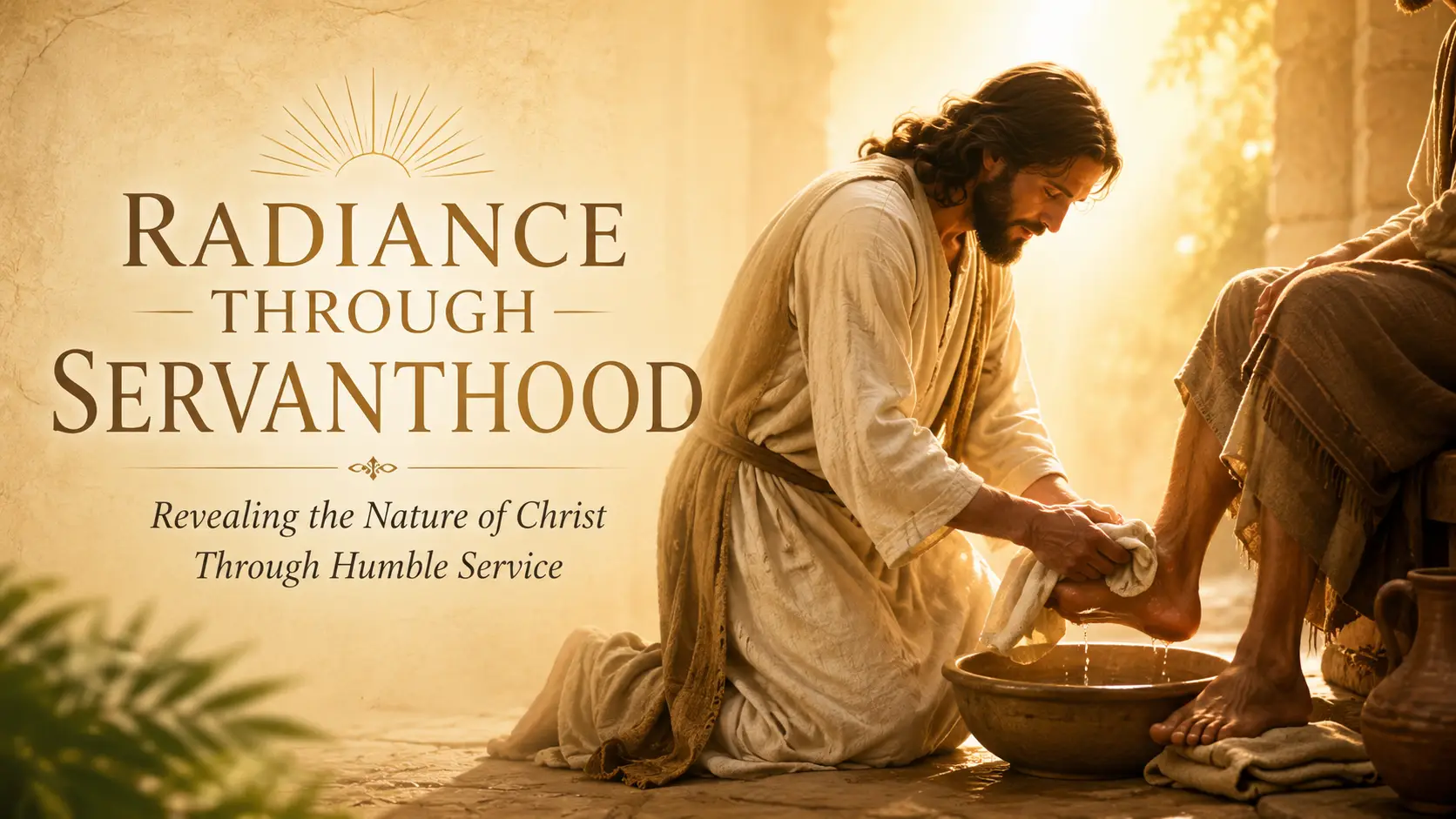
The radiance of Christ is not revealed merely through spiritual gifts, public ministry, influence, or position. One of the clearest manifestations of His glory is seen through humble servanthood. Jesus revealed the Father not only through what He preached but also through the way He stooped, served, washed feet, touched the rejected, cared for the broken, and ultimately laid down His life.
Servanthood is therefore not a lesser calling reserved for those without titles or authority. It is part of the very nature of Christ. The more Christ is formed within us, the more His servant-heart should become visible through us.
True spiritual radiance is not merely seen when we stand before people; it is often seen most clearly when we stoop to serve them.
The following qualities reveal practical ways in which the nature of Christ can be expressed through a life of servanthood.
QUALITIES OF A SERVANT
Learn to serve faithfully even when nobody sees, applauds, acknowledges, or rewards you.
Matthew 6:4 BSB
(4) so that your giving may be in secret. And your Father, who sees what is done in secret, will reward you.
God sees what is done in secret.
The servant of Christ does not require public recognition in order to remain faithful. When our service is truly offered to God, the approval of people becomes secondary. Some of the most significant acts of Kingdom service may never be noticed publicly, yet they are fully seen by the Father.
Ask yourself:
Would I still do this if nobody ever knew that I had done it?
-
Develop Endurance in Service
Do not allow inconvenience, disappointment, delay, lack of appreciation, or difficulty to determine whether you continue serving.
Galatians 6:9 BSB
(9) Let us not grow weary in well-doing, for in due time we will reap a harvest if we do not give up.
Faithful service is not merely enthusiastic at the beginning; it remains steadfast over time.
It is easy to serve when we are encouraged and appreciated. The deeper test comes when service becomes tiring, unnoticed, inconvenient, or costly. A mature servant learns to remain faithful beyond the excitement of the beginning.
Endurance reveals that our service is rooted in obedience rather than emotion.
-
Serve With Respect and Honour
Treat those whom God has placed around you with dignity. Honour authority without becoming a flatterer or a people-pleaser.
Colossians 3:23–24 BSB
(23) Whatever you do, work at it with your whole being, as for the Lord and not for men,
(24) because you know that you will receive an inheritance from the Lord as your reward. It is the Lord Christ you are serving.
Ultimately, our service is rendered to Christ.
When we understand this, even ordinary responsibilities become acts of worship. We do not serve diligently only when somebody important is watching. We serve with integrity because Christ is the One whom we ultimately represent.
Respectful service carries honour without flattery, submission without manipulation, and excellence without the need for praise.
-
Become Versatile and Adaptable
Do not insist that everyone must be served in the way you prefer to serve them. Learn to recognise the needs, weaknesses, backgrounds, and circumstances of others.
1 Corinthians 9:22 BSB
(22) To the weak I became weak, to win the weak. I have become all things to all people so that by all possible means I might save some.
Paul became “all things to all people” for the sake of reaching others.
Versatile service does not mean compromising truth. It means being willing to adapt our approach so that we can serve people effectively.
Different people require different expressions of care. One may need encouragement, another correction, another practical assistance, and another simply someone who will listen.
A servant does not continually ask, “Why can they not adapt to me?” Instead, the servant considers, “How can I serve this person in a way that genuinely helps them?”
-
Become a Peacemaker
Biblical appeasing service is not compromise. It is the ability to bring wisdom, grace, humility, and reconciliation into situations that could otherwise become destructive.
Abigail demonstrated this when she intervened between David and Nabal.
1 Samuel 25:32–33 BSB
(32) Then David said to Abigail, “Blessed be the LORD, the God of Israel, who sent you to meet me this day!
(33) Blessed is your discernment, and blessed are you, because today you kept me from bloodshed and from avenging myself by my own hand.
Abigail’s wisdom prevented a moment of anger from becoming a tragedy. She entered a volatile situation carrying humility, discernment, courage, and peace.
Christlike servants should have the same effect upon difficult environments. Instead of inflaming conflict, repeating gossip, feeding offence, or strengthening division, they become instruments of reconciliation.
Ask:
Does my presence escalate conflict or help bring peace and wisdom?
-
Serve Nobly
Noble service seeks the welfare of another even when it costs something personally.
The Good Samaritan gave his time, resources, attention, and personal involvement to help someone who could give him nothing in return.
Luke 10:33–35 BSB
(33) But a Samaritan on a journey came upon him, and when he saw him, he had compassion.
(34) He went to him and bandaged his wounds, pouring on oil and wine. Then he put him on his own animal, brought him to an inn, and took care of him.
(35) The next day he took out two denarii and gave them to the innkeeper. “Take care of him,” he said, “and on my return I will repay you for any additional expense.”
True compassion moves beyond sympathy and becomes action.
The Samaritan allowed another person’s need to interrupt his journey. He gave time, effort, resources, and personal attention. His service was not based upon what he could receive in return.
True servanthood asks:
What does this person need from me—not what can I gain from this person?
-
Become Trustworthy
Faithfulness is demonstrated through consistent deeds rather than impressive words.
Matthew 25:21 BSB
(21) His master replied, “Well done, good and faithful servant! You have been faithful with a few things; I will put you in charge of many things. Enter into the joy of your master!”
God entrusts greater responsibility to those who have proved faithful with what they have already received.
Trustworthiness is built through consistency. It is demonstrated when we keep our word, complete what has been entrusted to us, handle responsibility carefully, protect confidential matters, and remain faithful even when nobody is checking.
Be dependable.
Keep your word.
Handle responsibility carefully.
Serve when it is convenient and when it is not.
Faithfulness in small things prepares us for greater stewardship.
FINAL THOUGHT TO PONDER
The radiance of Christ is often most clearly seen in ordinary moments of extraordinary faithfulness.
- It appears when we serve without recognition.
- It appears when we continue after others have stopped appreciating us.
- It appears when we honour people who can offer us nothing.
- It appears when we adapt ourselves to help someone weaker.
- It appears when we calm conflict rather than inflame it.
- It appears when compassion costs us something.
- It appears when God discovers that what He has placed into our hands can be trusted there.
Servanthood is therefore not beneath spiritual maturity. Servanthood is one of its greatest evidences.
When Christ is truly being formed within us, the towel becomes as important as the platform, faithfulness becomes more important than recognition, and the question changes from:
“Who will serve me?”
to:
“Lord, whom can I serve today so that Your nature may be revealed through me?”
In Closing — Let the Servant Heart of Christ Be Seen
Radiance through servanthood is ultimately about becoming an accurate expression of Jesus Christ in the ordinary relationships and responsibilities of life. The world does not merely need to hear what we believe; it needs to encounter the nature of Christ through the way we live. Every act of humble service becomes an opportunity for His character to shine through us.
The true servant does not need a platform to reveal Christ. A meal prepared, a burden carried, a wounded person encouraged, an offence forgiven, a responsibility faithfully completed, a conflict peacefully resolved, or an unnoticed act of kindness can all become expressions of His glory.
May we therefore refuse the pursuit of greatness that seeks recognition and embrace the greatness Jesus demonstrated—the greatness of the towel, the basin, the surrendered heart, and the faithful servant.
As Christ is formed within us, may His servant-heart increasingly become visible through us, so that people encounter not merely our good works, but the radiance of the One whom we serve.
OTHER PUBLICATIONS BY THIS AUTHOR CAN BE FOUND AT: