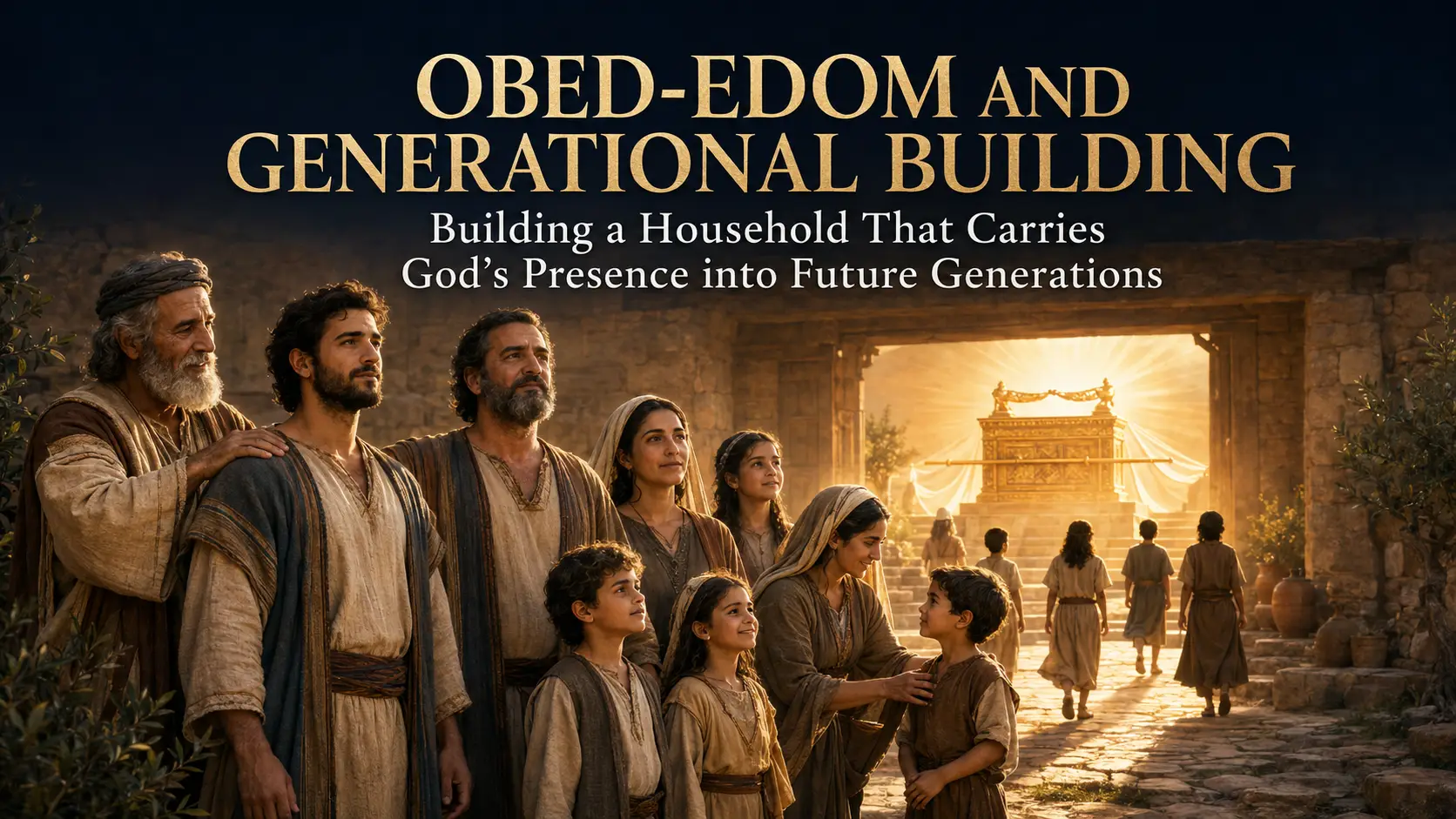
Building a Household That Carries God’s Presence into Future Generations
(3) Tell it to your children; let your children tell it to their children, and their children to the next generation.
Introduction into the Obed-Edom Generational Building
The account of Obed-Edom is often presented as a testimony of the blessing that comes when the presence of God is welcomed and honoured. However, his story is about far more than the personal blessing of one man. It reveals what can happen when God’s presence is intentionally hosted within a household and faithfully transferred to the next generation.
(11) Thus the ark of the LORD remained in the house of Obed-edom the Gittite for three months, and the LORD blessed him and all his household.
The ark remained in Obed-Edom’s house for only three months, but its influence did not end when David moved it to Jerusalem. The presence of God established something within his household that continued through his sons, grandsons, and extended family.
Obed-Edom did not merely experience a temporary visitation. He cultivated a generational legacy. His children did not inherit only the testimony of what God had done for their father; they inherited a responsibility to serve the purposes of God themselves.
(4) And Obed-edom also had sons: Shemaiah the firstborn, Jehozabad the second, Joah the third, Sachar the fourth, Nethanel the fifth,
(5) Ammiel the sixth, Issachar the seventh, and Peullethai the eighth. For God had blessed Obed-edom.
(6) Also to his son Shemaiah were born sons who ruled over their families because they were strong, capable men.
(7) Shemaiah’s sons were Othni, Rephael, Obed, and Elzabad; his brothers were Elihu and Semachiah, also capable men.
(8) All these were descendants of Obed-edom; they and their sons and brothers were capable men with strength to do the work—62 in all from Obed-edom.
The blessing upon Obed-Edom produced more than comfort, prosperity, or personal favour. It produced eight sons, capable grandsons, strong families, and sixty-two descendants who were prepared for service.
This is the true evidence of generational blessing: what God begins in one person becomes established in a household and is multiplied through future generations.
When viewed devotionally, the names of Obed-Edom’s eight sons present a prophetic picture of the spiritual qualities that should be developed and transferred from one generation to the next.
-
Shemaiah — The LORD Has Heard
(17) The righteous cry out, and the LORD hears; He delivers them from all their troubles.
Shemaiah reminds us that God hears the prayers of His people. The first characteristic of a household that hosts God’s presence should be prayer.
A praying household does not merely speak about God; it calls upon Him, listens for His voice, trusts His promises, and seeks His intervention. Prayer teaches the next generation that God is living, present, attentive, and involved in the lives of His people.
Children and spiritual sons and daughters must not inherit prayer only as a religious tradition. They must learn through experience that God hears them. Hannah cried out to God and received Samuel as an answer to prayer. Jeremiah was told to call upon the Lord and expect an answer. David repeatedly testified that God heard his cry and delivered him.
One of the greatest inheritances we can give the next generation is the confidence to approach God for themselves. They must not remain dependent upon the prayers of their parents or spiritual leaders. They must develop their own prayer lives, hear God’s voice, discern His leading, and learn to stand before Him in faith.
Prayer must therefore become part of the culture of our homes and ministries. The next generation should see us pray during difficulty, give thanks after deliverance, seek direction before making decisions, and intercede for others.
We must teach the next generation both to speak to God and to listen to Him. A praying generation will become a discerning generation. They will not be controlled by fear, confusion, cultural pressure, or human opinion because they have learned to seek the Lord.
Generational Application
We must teach the next generation both to speak to God and to listen to Him. A praying generation will become a discerning generation. They will not be controlled by fear, confusion, cultural pressure, or human opinion because they have learned to seek the Lord.
-
Jehozabad — The LORD Has Bestowed
(17) Every good and perfect gift is from above, coming down from the Father of the heavenly lights, with whom there is no change or shifting shadow.
Jehozabad reminds us that every good and perfect gift comes from God. A household that honours God recognises Him as the source of every blessing.
This understanding produces gratitude and protects the next generation from entitlement. Entitlement says, “I deserve what I have.” Gratitude says, “Everything I have has been entrusted to me by God.”
The abilities, opportunities, spiritual gifts, relationships, resources, influence, and assignments we receive are not self-created possessions. They are divine trusts that must be stewarded for God’s glory.
David understood this when he acknowledged that everything he and the people had given towards the building of the temple had first come from God. Solomon understood that he needed divine wisdom to fulfil the responsibility placed upon him. A generational household teaches its children to honour the Giver above the gift.
We must also help the next generation discover what God has placed within them. Their gifts may differ from ours. They are not called merely to repeat our methods or preserve our personal platforms. They must be prepared to express the purposes of God in their own generation.
True generational transfer does not control the gift. It recognises, develops, disciplines, equips, and releases it.
Generational Application
Teach children and spiritual sons and daughters to ask the following:
- What has God entrusted to me?
- How can I develop it faithfully?
- Whom is this gift intended to serve?
- How can it bring glory to God?
- What must I pass on to those who come after me?
What God establishes in one generation should not disappear when that generation passes away. It should be strengthened and multiplied through faithful stewardship.
-
Joah — The LORD Is My Brother
(11) For both the One who sanctifies and those who are sanctified are of the same family. So Jesus is not ashamed to call them brothers.
Joah speaks of relationship, nearness, belonging, and covenant family. God desires relationship before service. He is not merely building an organisation of workers; He is forming a household of sons and daughters.
The next generation must learn to serve God from a place of belonging rather than striving for acceptance. They must know that their identity is not based upon performance, position, public recognition, or ministry success. Their identity is rooted in their relationship with Christ and their place within the family of God.
Where relationship is absent, service can become legalistic, competitive, and exhausting. People begin to labour for approval rather than from love. They compare themselves with others, become threatened by the gifts of their brethren, and measure their value by visible results.
A healthy spiritual household communicates both belonging and responsibility. Sons and daughters know that they are loved, but they are also trained, corrected, matured, and prepared for service. Correction does not communicate rejection, and responsibility does not replace relationships.
Obed-Edom’s household was not merely blessed as a collection of individuals. It became a family that served together. God’s presence created a shared identity and a common purpose.
Generational Application

Our homes and ministries should become places where people encounter the Father, grow in sonship, discover their covenant identity, and learn to honour one another as members of the same spiritual household.
Biological children and spiritual sons and daughters must know that they have a place at the table, a voice within the family, and a responsibility within God’s purposes.
-
Sachar — Reward
(6) And without faith it is impossible to please God, because anyone who approaches Him must believe that He exists and that He rewards those who earnestly seek Him.
Sachar reminds us that God honours those who diligently seek Him. Although Scripture speaks of God’s reward, the greatest reward is not material prosperity, position, or recognition. The greatest reward is God Himself.
The next generation must be taught to value the secret place above the public platform. They must understand that the applause of people is temporary, but the approval of God carries eternal significance.
Much of what God rewards is done in secret: prayer when nobody is watching, obedience when nobody applauds, integrity when compromise would be easier, generosity without recognition, and service that receives no public acknowledgement.
If the next generation is trained to seek visible rewards, they may abandon their assignment when recognition does not come. However, when they learn to seek God Himself, they can remain faithful through hidden seasons, delays, disappointments, and opposition.
A generational legacy is often built through unseen acts of obedience. What appears insignificant in one season may become the foundation upon which future generations stand.
Generational Application
Teach the next generation that hidden faithfulness is never wasted. God sees every sacrifice, every prayer, every act of obedience, and every service performed for His glory.
They must learn to seek God because He is worthy—not merely because they expect Him to give them something.
-
Nethanel — Given by God
(3) Children are indeed a heritage from the LORD, and the fruit of the womb is His reward.
Nethanel reminds us that children are gifts entrusted to us by God. Biological children, spiritual sons and daughters, and younger believers are not possessions to be controlled. They are divine trusts to be loved, nurtured, instructed, equipped, and released into the purposes of God.
A generational household does not view the next generation as an inconvenience or an interruption. It recognises that the future of the household is already present within its children.
Children must be intentionally discipled. We cannot assume that they will automatically inherit our convictions, values, spiritual understanding, or devotion to God. What one generation receives through revelation must be taught, demonstrated, and modelled to the next.
The next generation watches how we respond to conflict, disappointment, correction, financial pressure, success, and failure. They learn not only from what we preach but also from what we practise.
Spiritual sons and daughters must likewise be nurtured without being controlled or used to preserve someone else’s ministry. Spiritual parenthood prepares people to fulfil God’s calling, even when their assignment eventually extends beyond the structures in which they were formed.
Generational Application
We must ask whether we are merely raising children who know church language or forming sons and daughters who know God, love His Word, honour His presence, and understand their Kingdom responsibility.
The goal is not simply to keep the next generation close to us. The goal is to prepare them to remain close to God and faithfully fulfil His purposes.
-
Ammiel — People of God
(9) But you are a chosen people, a royal priesthood, a holy nation, a people for God’s own possession, to proclaim the virtues of Him who called you out of darkness into His marvelous light.
(10) Once you were not a people, but now you are the people of God; once you had not received mercy, but now you have received mercy.
Ammiel reminds us that God’s people belong to Him and carry a covenant identity. A consecrated household understands who it is and to whom it belongs.
The world continually attempts to define the next generation according to culture, popularity, possessions, appearance, success, sexuality, status, and personal achievement. If children and spiritual sons and daughters do not receive a clear Kingdom identity, they will look to the world to tell them who they are.
Covenant identity declares:
- We belong to God.
- We have been redeemed by Christ.
- We are members of His household.
- We are a royal priesthood and a holy nation.
- We have been called out of darkness.
- We exist to proclaim His virtues.
- Our lives are governed by His Word and purposes.
Belonging to the people of God is more than attending church meetings. It means sharing a covenant identity, carrying responsibility for one another, submitting to the authority of Scripture, and participating in the life and mission of God’s household.
The next generation must experience the Church as a spiritual family in which they are known, loved, corrected, equipped, and given meaningful opportunities to serve.
Generational Application
Identity must be established before assignment. When people do not know who they are, they will use their gifts to prove themselves. When they know that they belong to God, they can serve from security, humility, and love.
-
Issachar — There Is Reward
(58) Therefore, my beloved brothers, be steadfast and immovable. Always excel in the work of the Lord, because you know that your labor in the Lord is not in vain.
Issachar reminds us that God never overlooks faithful service. Nothing done in obedience to the Lord is wasted.
Generational legacy requires more than enthusiasm at the beginning of an assignment. It requires endurance, consistency, faithfulness, and the willingness to continue when results are not immediately visible.
Many people begin well but withdraw when ministry becomes difficult, relationships become demanding, or their efforts are not acknowledged. The next generation must be prepared to serve through changing seasons without abandoning its commitment to God.
Faithfulness is developed through ordinary acts of obedience repeated over time. It is found in keeping promises, completing responsibilities, honouring relationships, serving when it is inconvenient, and remaining committed when there is no immediate reward.
The sixty-two descendants of Obed-Edom did not become capable servants accidentally. They belonged to a household in which service, responsibility, strength, and faithfulness had become part of the family culture.
Generational Application
We must teach the next generation that faithfulness is more valuable than temporary visibility. God is not impressed merely by how strongly we begin; He desires that we remain steadfast and complete what He has entrusted to us.
Our labour may not always produce immediate results, but obedience plants seeds that future generations may harvest.
-
Peullethai — My Work Is for the LORD
(23) Whatever you do, work at it with your whole being, as for the Lord and not for men,
(24) because you know that you will receive an inheritance from the Lord as your reward. It is the Lord Christ you are serving.
The name Peullethai is associated with work and labour. As a prophetic principle, it calls every generation to declare, “My work is for the Lord.”
Everything we do should ultimately be offered to God for His glory. Work becomes worship when it is performed wholeheartedly, faithfully, and with the awareness that Christ is the One we are serving.
This principle removes the false division between sacred and secular work. A believer may serve God through preaching, teaching, prayer, administration, business, education, government, healthcare, agriculture, skilled labour, the arts, or caring for a household. The workplace becomes a place of Kingdom service when the believer works with integrity and represents Christ.
The next generation must not be lost between the Church and the world. They must be taught that their careers, abilities, education, businesses, and professions can become instruments through which the purposes of God are advanced.
They should be prepared to serve both within the gathered Church and throughout the marketplace. They must carry the character of Christ, the wisdom of God, and the values of His Kingdom wherever He sends them.
Generational Application
Teach children and spiritual sons and daughters to pursue excellence without becoming controlled by ambition. They should work diligently, but their ultimate goal must be to please the Lord rather than gain the approval of people.
They must understand that their work is an altar, their gifts are an offering, and their daily conduct is a testimony.
From Eight Sons to Sixty-Two Capable Servants
The most powerful aspect of Obed-Edom’s legacy is not merely that he had eight sons. It is that the blessing continued through those sons until Scripture could identify sixty-two capable descendants with strength to do the work.
What began with one man opening his home to the presence of God became a multigenerational household of service.
This reveals several important principles:
- The Presence Must Become a Household Culture
The presence of God must not be confined to church meetings or special occasions. Prayer, worship, honour, obedience, and reverence should become part of everyday household life.
- Testimonies Must Be Intentionally Transferred
Every generation must tell the next generation what God has done. Testimony builds faith and helps children understand that they belong to a continuing story of God’s faithfulness.
- Blessing Must Produce Responsibility
The blessing of God is not given merely for personal enjoyment. It equips people to serve, bless others, and advance the purposes of His Kingdom.
- Sons and Daughters Must Be Trained
Potential does not automatically become maturity. The next generation must be instructed, corrected, mentored, trusted, and given opportunities to carry responsibility.
- Succession Must Be Prepared Before It Is Needed
Generational transfer should not begin only when a leader becomes old, tired, or unable to continue. Sons and daughters should be prepared while the present generation is still able to walk with them.
- The Next Generation Must Be Released
Healthy fathers and mothers do not merely gather sons and daughters around themselves. They prepare and release them to fulfil God’s purposes, even when their assignments develop beyond the previous generation’s experience.
A Call to Generational Stewardship
Every believer carries a responsibility towards the next generation. This responsibility belongs not only to biological parents. It also belongs to spiritual fathers, pastors, elders, ministry leaders, teachers, mentors, employers, and mature believers.
We must ask ourselves:
- What is the next generation learning about God by watching my life?
- Am I modelling prayer, gratitude, covenant relationship, faithfulness, and wholehearted service?
- Whom am I intentionally discipling?
- What testimony, wisdom, values, and responsibility am I transferring?
- Am I creating room for younger believers to grow, serve, make mistakes, and mature?
- Am I building something that can continue faithfully after I am gone?
The next generation should not merely inherit our buildings, programmes, titles, or organisational structures. They must inherit a living relationship with God, a love for His presence, a reverence for His Word, a covenant identity, a servant heart, and the spiritual capacity to carry His purposes forward.
Conclusion
The blessing of Obed-Edom did not stop with Obed-Edom. It moved from a man to his household, from his household to his sons, from his sons to their children, and from one generation of servants to another.
This is the legacy God desires to establish among His people.
The question is not only whether the presence of God is blessing us. The deeper question is whether His presence is forming something within us that can be faithfully transferred to those who come after us.
May God raise households in which prayer is heard, gifts are stewarded, covenant relationships are honoured, His presence is treasured, children are valued, identity is established, faithfulness is rewarded, and all work is offered to the Lord.
May biological children, spiritual sons and daughters, and the younger generation arise as capable men and women with strength for service.
May they carry the presence, character, wisdom, and apostolic purposes of God into generations yet to come.
Grace and peace to you.
OTHER PUBLICATIONS BY THIS AUTHOR CAN BE FOUND AT: